In today’s Steady Investor, we break down what’s driving the market’s current strength, and what could test it next, including:
- Mortgage lock-in constrains housing supply
- Private credit risks for 401(k)s
- Emerging Markets show resilient growth
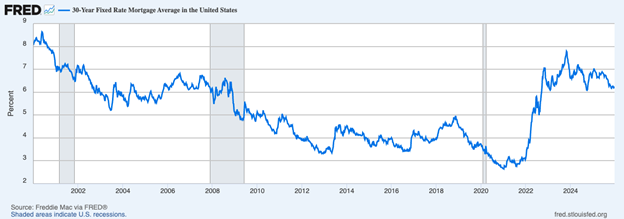
Mortgage Rates Have Eased, But the Housing Market is Yet to Respond – Mortgage rates have fallen to their lowest levels in a year (chart below), but for many homeowners, that relief hasn’t been enough to restart the housing market.1
What Matters for Markets as 2025 Comes to a Close
Market conditions are shifting quickly as the year ends, with policy decisions, growth signals, and risk sentiment all in focus. While headlines move fast, investors need clarity on what actually matters beneath the surface.
Our free December 2025 Zacks Market Strategy Report3 breaks down the key market and economic developments investors should be paying attention to right now. Read it today to catch up on the most important issues shaping the outlook, including:
- All Eyes on Fed December Meeting, and What Lies Ahead
- The Sharp Selloff in Bitcoin
- Making Sense of the Market’s Tech Worries
- Plus, more essential market and economic stories
If you have $500,000 or more, fill out the form to receive your free report today!
Download our complimentary December 2025 Market Strategy Report3
Roughly 30 million U.S. households (or more than half of primary mortgage holders) have mortgage rates at or below 4%. Most locked in those rates during the refinancing wave of 2020 and 2021. Fast forward to today, the idea of giving up a sub-3% mortgage for a loan north of 6% remains a tough tradeoff. This so-called “lock-in effect” continues to suppress housing supply. Many homeowners who might otherwise move are choosing to stay put, keeping inventories well below historical norms and limiting transaction activity across much of the country. Meanwhile, home prices are still near record highs in many markets, while recurring costs such as insurance and property taxes have risen. Even modestly lower mortgage rates haven’t been enough to offset the jump in monthly payments buyers would face by moving. According to Realtor.com, a buyer who paid roughly $1,300 per month on a mortgage in recent years would need to spend more than $2,200 to purchase a median-priced home today. For now, lower mortgage rates may help at the margins. But until rates, prices, or incomes shift more decisively, the lock-in effect is likely to remain a defining feature of the housing market.
Private Equity is Getting Pitched to 401(k)s. Investors Should be Cautious – The trend is accelerating: private credit is getting pushed into 401(k) plans, with managers arguing that the asset class can offer diversification and steady income. But the experience of individual investors already exposed to similar products has been less encouraging in 2025.Publicly traded private-credit vehicles known as business development companies, or BDCs, have come under pressure as market conditions shifted.BDCs typically lend to midsize companies with below-investment-grade credit ratings, using the interest income to pay relatively high dividends. They became a popular access point for individual investors as private credit grew, with assets in the space more than tripling since 2020 to roughly $450 billion, according to industry estimates.In 2025, however, performance lagged. An exchange-traded fund tracking BDCs has declined while the broader stock market has risen, reflecting a combination of falling interest rates, loan losses at a handful of high-profile funds, and growing investor unease around credit quality.The pullback illustrates an important feature of private credit: while returns can appear stable during favorable periods, the asset class can be sensitive to both interest-rate changes and credit events. Unlike public bonds, many private loans don’t trade frequently, which can make exits difficult and price adjustments abrupt when conditions change.The broader debate now centers on suitability rather than viability. While institutional investors with long-time horizons and limited liquidity needs may be able to absorb private credit’s complexities, the experience of retail-focused vehicles highlights the tradeoffs involved, especially for investors who may react to volatility or need flexibility.4
How Emerging Markets Could be a Hidden Growth Story – Trade policy has dominated the macro conversation for much of 2025, and tariffs have naturally pulled attention toward exports, supply chains, and cross-border flows. But that has overshadowed an interesting development in many Emerging Markets, where internal demand and service-driven growth have held up better than many expected.In Latin America, for example, tariff-related uncertainty has been loud, yet recent GDP data suggest broad economic activity has not fallen apart. In Brazil, output was essentially flat in the most recent quarter, but services still managed to grow modestly, and consumer spending did not roll over. Across Asia, the same pattern appears in different form. India continues to post rapid year-over-year growth, and services have remained a major engine alongside still-solid consumer demand. Indonesia has also seen household consumption continue to rise at a healthy pace. The takeaway isn’t that every Emerging Market is booming. It’s that the sources of growth are more diversified than the headlines imply.5
Markets Are Shifting—Are You Positioned for What’s Next? Year-end brings heightened uncertainty as policy decisions, growth signals, and risk sentiment evolve. Even modest changes could drive meaningful shifts in market pricing.
Our free December 2025 Zacks Market Strategy Report6 breaks down what’s developing beneath the surface, and how investors can stay proactive, not reactive. Grab your copy now and get up to speed on other critical market themes, including:
- All Eyes on Fed December Meeting, and What Lies Ahead
- The Sharp Selloff in Bitcoin
- Making Sense of the Market’s Tech Worries
- Plus, more essential market and economic stories
If you have $500,000 or more, fill out the form to receive your free report today!
Disclosure
2 Fred Economic Data. December 18, 2025. https://fred.stlouisfed.org/series/MORTGAGE30US
3 Zacks Investment Management reserves the right to amend the terms or rescind the free Market Strategy Report offer at any time and for any reason at its discretion.
4 Wall Street Journal. December 21, 2025. https://www.wsj.com/finance/investing/the-private-credit-party-turns-ugly-for-individual-investors-287356f9?mod=djemMoneyBeat_us
5 Advisor Perspectives. December 22, 2025. https://www.advisorperspectives.com/articles/2025/12/22/emerging-markets-optimism-2026-stellar-year
6 Zacks Investment Management reserves the right to amend the terms or rescind the free Market Strategy Report offer at any time and for any reason at its discretion.
DISCLOSURE
Past performance is no guarantee of future results. Inherent in any investment is the potential for loss.
Zacks Investment Management, Inc. is a wholly-owned subsidiary of Zacks Investment Research. Zacks Investment Management is an independent Registered Investment Advisory firm and acts as an investment manager for individuals and institutions. Zacks Investment Research is a provider of earnings data and other financial data to institutions and to individuals.
This material is being provided for informational purposes only and nothing herein constitutes investment, legal, accounting or tax advice, or a recommendation to buy, sell or hold a security. Do not act or rely upon the information and advice given in this publication without seeking the services of competent and professional legal, tax, or accounting counsel. Publication and distribution of this article is not intended to create, and the information contained herein does not constitute, an attorney-client relationship. No recommendation or advice is being given as to whether any investment or strategy is suitable for a particular investor. It should not be assumed that any investments in securities, companies, sectors or markets identified and described were or will be profitable. All information is current as of the date of herein and is subject to change without notice. Any views or opinions expressed may not reflect those of the firm as a whole.
Any projections, targets, or estimates in this report are forward looking statements and are based on the firm’s research, analysis, and assumptions. Due to rapidly changing market conditions and the complexity of investment decisions, supplemental information and other sources may be required to make informed investment decisions based on your individual investment objectives and suitability specifications. All expressions of opinions are subject to change without notice. Clients should seek financial advice regarding the appropriateness of investing in any security or investment strategy discussed in this presentation.
Certain economic and market information contained herein has been obtained from published sources prepared by other parties. Zacks Investment Management does not assume any responsibility for the accuracy or completeness of such information. Further, no third party has assumed responsibility for independently verifying the information contained herein and accordingly no such persons make any representations with respect to the accuracy, completeness or reasonableness of the information provided herein. Unless otherwise indicated, market analysis and conclusions are based upon opinions or assumptions that Zacks Investment Management considers to be reasonable. Any investment inherently involves a high degree of risk, beyond any specific risks discussed herein.
The S&P 500 Index is a well-known, unmanaged index of the prices of 500 large-company common stocks, mainly blue-chip stocks, selected by Standard & Poor’s. The S&P 500 Index assumes reinvestment of dividends but does not reflect advisory fees. The volatility of the benchmark may be materially different from the individual performance obtained by a specific investor. An investor cannot invest directly in an index.