In this week’s Steady Investor, we look at several developments that could shape the investment landscape in the months ahead, including:
- Fed reviews key policy issues
- Housing affordability remains challenged
- Iran tensions pressure oil markets
Warsh’s Fed Overhaul Begins With Five Advisory Task Forces – Federal Reserve Chair Kevin Warsh is starting to put his stamp on the central bank, naming outside advisers to lead five task forces that will review how the Fed operates.The groups will focus on productivity and jobs, public communications, the Fed’s balance sheet, inflation, and the quality of economic data used to guide policy. Put another way, Warsh wants a fresh look at some of the biggest questions facing the Fed, which include how AI could affect productivity and employment, whether the Fed should say less about future policy, how large its bond portfolio should be, how it should think about inflation after the post-pandemic surge, and whether traditional government data are still enough to understand a changing economy.That is a broad agenda, and it fits with Warsh’s stated desire to rethink parts of the post-2008 Fed playbook. Some investors may see this story and envision a “shake-up” is coming, which could potentially create instability or uncertainty in the U.S. financial system as we know it. In reality, however, we should not view these task forces as a coming tidal wave of change. The task forces are advisory only—they can produce recommendations, but the Federal Open Market Committee is under no obligation to adopt them. Any meaningful change would still require buy-in from Fed governors, regional bank presidents, and staff.What we’re seeing at this stage is not a new Fed operating model, but rather a signal of where Warsh wants the debate to go. The process may produce real changes, but it could also end with a set of reports and incremental adjustments.1
8 Retirement Mistakes to Avoid
Markets are constantly evolving, from shifts in Federal Reserve policy to geopolitical uncertainty and changing economic conditions. Staying focused on the long term can be just as important as reacting to today’s headlines.
That’s why we created this free guide: 8 Retirement Mistakes to Avoid2.
Inside, you’ll learn about common pitfalls that can quietly derail a retirement plan and practical strategies to help keep your finances on track regardless of market conditions.
It covers topics such as:
- How being too conservative can leave you short of retirement income
- The hidden risks of making emotional investment decisions
- Why trying to time the market can derail long-term results
- Plus, many more mistakes we regularly see, with our insights on how to avoid them
If you have $500,000 or more to invest and want to learn more, click on the link below to get your free copy:
Download Our Free Guide: 8 Retirement Mistakes to Avoid!2
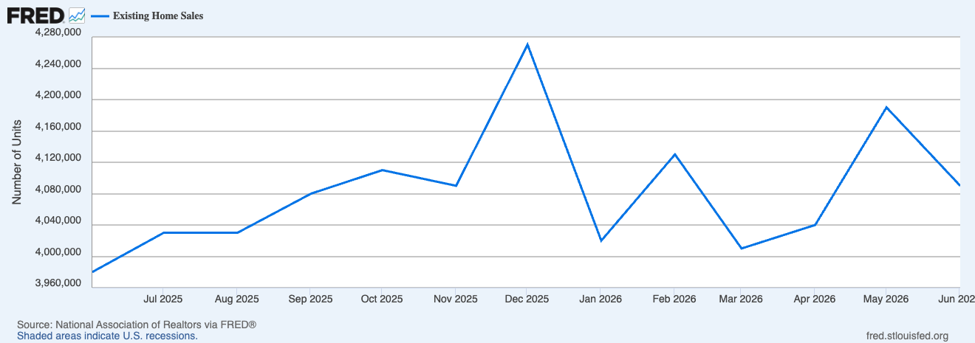
The U.S. Housing Market Is Still Waiting on Better Affordability – Existing-home sales fell 2.4% in June to a seasonally adjusted annual rate of 4.09 million, ending the key spring selling season with a whimper. Economists had expected sales to rise, which makes the decline another reminder that housing remains highly sensitive to affordability.The national median existing-home price reached a record $440,600 in June, up 1.8% from a year earlier, while the 30-year fixed mortgage rate recently averaged 6.43%. That combination continues to make monthly payments difficult for would-be buyers, especially first-time buyers.To be fair, there were also some minor signs of improvement in the latest batch of housing data. June sales were still 2.8% higher than a year ago, inventory has improved, and wage growth is running ahead of home-price growth. But the recovery remains uneven because small changes in mortgage rates can still change the math quickly for buyers, and with the war in Iran potentially back on, upward pressure on the long end of the curve could be nigh.In our view, until affordability improves more meaningfully—through lower rates, slower price growth, higher incomes, or some combination—the housing market is likely to remain stuck in a stop-and-start recovery.3
Existing Home Sales Over the Past Year (# of Units)
Renewed Iran Fighting Puts Oil Inventories Back in Focus – Oil prices had calmed after the temporary U.S.-Iran ceasefire, but the latest exchange of fire is a reminder that the energy market’s biggest vulnerability has not gone away. And that vulnerability is inventories. U.S. commercial crude stockpiles rose by 3 million barrels last week, the first increase after 10 straight weekly drawdowns, but reserves remain low. The Strategic Petroleum Reserve recently fell to its lowest level since 1983, while the Cushing, Oklahoma storage hub has reportedly reached operational limits that could make further withdrawals difficult. The issue is even more pronounced in refined products. Gulf Coast gasoline inventories are well below normal seasonal levels, diesel stocks are near their lowest levels since the early 2000s, and U.S. fuel exports remain elevated as American refineries help replace disrupted supply abroad. Gasoline prices have already risen meaningfully since the conflict began, even though crude prices are well below their spring highs. For investors, if fighting continues or Hormuz traffic is disrupted again, the market may have less cushion than it did earlier this year. The current risk is not just higher crude prices, but renewed pressure across gasoline, diesel, inflation, and consumer spending.5
Are You Making These Common Retirement Planning Mistakes? Planning for retirement isn’t just about growing your savings, it’s also about avoiding the common mistakes that can quietly get in the way. The good news is that many of these pitfalls can be identified and addressed before they have a lasting impact.
Download our free guide, 8 Retirement Mistakes to Avoid5, to learn practical strategies that can help protect your savings and support your long-term financial goals. Inside, you’ll get insight into:
- How being too conservative can leave you short of retirement income
- The hidden risks of making emotional investment decisions
- Why trying to time the market can derail long-term results
- Plus, many more mistakes we regularly see, with our insights on how to avoid them
If you have $500,000 or more to invest and want to learn more, click on the link below to get your free copy:
Disclosure
2 ZIM may amend or rescind the free guide “8 of the biggest retirement mistakes investors should avoid” for any reason and at ZIM’s discretion
3 Wall Street Journal. July 9, 2026. https://www.wsj.com/economy/housing/spring-home-selling-season-ends-on-a-bad-note-a81071a0?mod=economy_lead_pos1
4 Fred Economic Data. July 9, 2026. https://fred.stlouisfed.org/series/EXHOSLUSM495S
5 Wall Street Journal. July 5, 2026. https://www.wsj.com/finance/commodities-futures/a-sudden-glut-of-oil-threatens-to-weaken-irans-hand-in-talks-adfcf7c0?mod=series_israeliranhav
6 ZIM may amend or rescind the free guide “8 of the biggest retirement mistakes investors should avoid” for any reason and at ZIM’s discretion
DISCLOSURE
Past performance is no guarantee of future results. Inherent in any investment is the potential for loss.
Zacks Investment Management, Inc. is a wholly-owned subsidiary of Zacks Investment Research. Zacks Investment Management is an independent Registered Investment Advisory firm and acts as an investment manager for individuals and institutions. Zacks Investment Research is a provider of earnings data and other financial data to institutions and to individuals.
This material is being provided for informational purposes only and nothing herein constitutes investment, legal, accounting or tax advice, or a recommendation to buy, sell or hold a security. Do not act or rely upon the information and advice given in this publication without seeking the services of competent and professional legal, tax, or accounting counsel. Publication and distribution of this article is not intended to create, and the information contained herein does not constitute, an attorney-client relationship. No recommendation or advice is being given as to whether any investment or strategy is suitable for a particular investor. It should not be assumed that any investments in securities, companies, sectors or markets identified and described were or will be profitable. All information is current as of the date of herein and is subject to change without notice. Any views or opinions expressed may not reflect those of the firm as a whole.
Any projections, targets, or estimates in this report are forward looking statements and are based on the firm’s research, analysis, and assumptions. Due to rapidly changing market conditions and the complexity of investment decisions, supplemental information and other sources may be required to make informed investment decisions based on your individual investment objectives and suitability specifications. All expressions of opinions are subject to change without notice. Clients should seek financial advice regarding the appropriateness of investing in any security or investment strategy discussed in this presentation.
Certain economic and market information contained herein has been obtained from published sources prepared by other parties. Zacks Investment Management does not assume any responsibility for the accuracy or completeness of such information. Further, no third party has assumed responsibility for independently verifying the information contained herein and accordingly no such persons make any representations with respect to the accuracy, completeness or reasonableness of the information provided herein. Unless otherwise indicated, market analysis and conclusions are based upon opinions or assumptions that Zacks Investment Management considers to be reasonable. Any investment inherently involves a high degree of risk, beyond any specific risks discussed herein.
The S&P 500 Index is a well-known, unmanaged index of the prices of 500 large-company common stocks, mainly blue-chip stocks, selected by Standard & Poor’s. The S&P 500 Index assumes reinvestment of dividends but does not reflect advisory fees. The volatility of the benchmark may be materially different from the individual performance obtained by a specific investor. An investor cannot invest directly in an index.