Markets remain resilient even as the economic outlook continues to evolve. In this issue of Steady Investor, we take a closer look at several developments shaping the investment landscape, including:
- How rising yields affect consumers
- SEC scrutiny of pre-IPO funds
- What’s really driving the economy
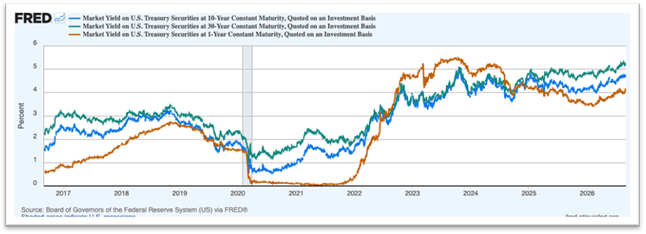
Should U.S. Consumers Be Worried About Rising Treasury Yields? Readers have likely seen the stories all over the financial media and elsewhere—U.S. Treasury bond yields are on the rise. But rising bond yields are not just a Treasury market story. They can affect borrowing costs across the economy, from mortgages and auto loans to corporate debt and stock valuations.
Let’s focus on mortgage rates as one example. Because mortgage borrowing rates are closely tied to the 10-year Treasury yield, higher bond yields could push the 30-year fixed mortgage rate closer to 7%. Freddie Mac said the average rate was already 6.66% last week, another challenge for a housing market that has struggled with affordability for several years. Auto loans are also exposed. Car financing costs are tied more closely to medium-term Treasury yields, and the five-year yield recently reached its highest level since January 2025.1
Markets Have Been Resilient. Is Your Strategy Ready for What’s Next?
From rising borrowing costs to shifting expectations for the economy and markets, investors have plenty of reasons to feel uncertain about what comes next. But uncertainty doesn’t have to mean changing course.
Our free guide, Navigating Market Volatility3, offers four principles for staying disciplined when markets become unpredictable. Download your free copy today to learn more about:
- Sharp market declines and corrections are a normal part of investing
- The best market days come unexpectedly (often within days or weeks of the worst days)
- Trying to pick market tops and bottoms is nearly impossible
- Trust your strategy and discipline, not the headlines
- Plus, more insights and assistance to help you keep your investment strategy on course
If you have $500,000 or more to invest, get your free volatility guide today!
Download Your Free Copy Today: Navigating Market Volatility: 4 Principles for Staying the Course3
These pressures can affect spending at the margins. But it is also important to keep the move in perspective. Treasury yields are elevated relative to the ultra-low-rate years, but they are not unusually high by longer-term historical standards. The other side of the story, too, is that a steeper yield curve can improve the economics of bank lending, since banks often borrow short and lend long. It can also signal that markets see stronger growth ahead, not just higher inflation risk.
Private Funds That Offer “Early Access to IPOs” Come Under Scrutiny – The SEC is taking a closer look at investment vehicles that claim to offer exposure to shares of high-profile private companies. The focus is on special purpose vehicles, or SPVs, which are often marketed as a way for investors to gain exposure to fast-growing startups before they go public. According to recent reporting, SEC examiners have been asking registered investment advisers to prove that their SPVs actually own, or have legitimate exposure to, the private-company shares they claim to offer.One recent example illustrates the issue. An SPV fund reportedly marketed pre-IPO exposure to SpaceX, but later told investors the shares had been sold before the company began trading. That meant investors did not receive the full benefit they may have expected from owning exposure through the IPO event.This highlights the broader risk to the notoriously opaque private markets—some SPVs own shares directly, while others invest through layered or indirect structures. That can make it harder to understand ownership, fees, liquidity, and exit timing.Public markets can be volatile, sure, but they also generally offer clearer pricing, stronger disclosure, and daily liquidity. That should matter more to investors than trying to hit a home run and score outsized, short-term returns.4
The Alphabet Soup of the U.S. Economy – Ask any economist how the U.S. economy is currently holding up, and the response is likely to be a letter of the alphabet. The debate is arguably getting too silly to follow. For years, the popular label was “K-shaped,” meaning higher-income households were pulling away while lower-income households struggled. More recently, some have argued the economy is becoming “C-shaped,” with lower- and middle-income consumers gaining ground, while the wealthy’s gains are tapered. Others say “E-shaped” is more accurate, with different income groups moving on separate but relatively stable tracks.There is some data behind the debate. Some measures show the spending gap between income groups narrowing, and some companies have reported improvement among middle-income customers.The problem is that the labels may make the economy sound more precise than it really is. Different households are experiencing this economy differently, especially with housing, borrowing costs, gas prices, and everyday expenses still elevated. But that has almost always been true.For investors, the bigger question is not whether the economy looks like a K, C, or E. It is whether consumer spending, business investment, employment, and corporate earnings remain strong enough to support the expansion. For now, we think the answer is yes.5
Is Your Investment Strategy Ready for Changing Markets? Market conditions can shift quickly, making it difficult to know which developments deserve your attention. Rather than reacting to every change, investors can benefit from a strategy designed to stay on course through different market environments.
Our free guide, Navigating Market Volatility6, outlines four principles to help investors manage uncertainty, avoid common mistakes, and stay focused on their long-term goals. Inside, you’ll learn:
- Sharp market declines and corrections are a normal part of investing
- The best market days come unexpectedly (often within days or weeks of the worst days)
- Trying to pick market tops and bottoms is nearly impossible
- Trust your strategy and discipline, not the headlines
- Plus, more insights and assistance to help you keep your investment strategy on course
If you have $500,000 or more to invest, access your free volatility guide today.
Disclosure
2 FRED, Federal Reserve Bank of St. Louis. Market Yield on U.S. Treasury Securities at 10-Year Constant Maturity, Quoted on an Investment Basis (DGS10). September 3, 2026.
3 Zacks Investment Management reserves the right to amend the terms or rescind the free Navigating Market Volatility: 4 Principles for Staying the Course offer at any time and for any reason at its discretion.
4 Wall Street Journal. August 31, 2026. “SEC Presses Investment Firms to Prove They Have Access to Shares in Hot Startups.”
5 CNBC. August 29, 2026. “K, C or E? Why Economists Can't Agree on the Shape of Today's Economy.”
6 Zacks Investment Management reserves the right to amend the terms or rescind the free Navigating Market Volatility: 4 Principles for Staying the Course offer at any time and for any reason at its discretion.
DISCLOSURE
Past performance is no guarantee of future results. Inherent in any investment is the potential for loss.
Zacks Investment Management, Inc. is a wholly-owned subsidiary of Zacks Investment Research. Zacks Investment Management is an independent Registered Investment Advisory firm and acts as an investment manager for individuals and institutions. Zacks Investment Research is a provider of earnings data and other financial data to institutions and to individuals.
This material is being provided for informational purposes only and nothing herein constitutes investment, legal, accounting or tax advice, or a recommendation to buy, sell or hold a security. Do not act or rely upon the information and advice given in this publication without seeking the services of competent and professional legal, tax, or accounting counsel. Publication and distribution of this article is not intended to create, and the information contained herein does not constitute, an attorney-client relationship. No recommendation or advice is being given as to whether any investment or strategy is suitable for a particular investor. It should not be assumed that any investments in securities, companies, sectors or markets identified and described were or will be profitable. All information is current as of the date of herein and is subject to change without notice. Any views or opinions expressed may not reflect those of the firm as a whole.
Any projections, targets, or estimates in this report are forward looking statements and are based on the firm’s research, analysis, and assumptions. Due to rapidly changing market conditions and the complexity of investment decisions, supplemental information and other sources may be required to make informed investment decisions based on your individual investment objectives and suitability specifications. All expressions of opinions are subject to change without notice. Clients should seek financial advice regarding the appropriateness of investing in any security or investment strategy discussed in this presentation.
Certain economic and market information contained herein has been obtained from published sources prepared by other parties. Zacks Investment Management does not assume any responsibility for the accuracy or completeness of such information. Further, no third party has assumed responsibility for independently verifying the information contained herein and accordingly no such persons make any representations with respect to the accuracy, completeness or reasonableness of the information provided herein. Unless otherwise indicated, market analysis and conclusions are based upon opinions or assumptions that Zacks Investment Management considers to be reasonable. Any investment inherently involves a high degree of risk, beyond any specific risks discussed herein.
It is not possible to invest directly in an index. Investors pursuing a strategy similar to an index may experience higher or lower returns, which will be reduced by fees and expenses.
Returns for each strategy and the corresponding Morningstar Universe reflect the annualized returns for the periods indicated. The Morningstar Universes used for comparative analysis are constructed by Morningstar (median performance) and data is provided to Zacks by Zephyr Style Advisor. The percentile ranking for each Zacks Strategy is based on the gross comparison for Zacks Strategies vs. the indicated universe rounded up to the nearest whole percentile. Other managers included in universe by Morningstar may exhibit style drift when compared to Zacks Investment Management portfolio. Neither Zacks Investment Management nor Zacks Investment Research has any affiliation with Morningstar. Neither Zacks Investment Management nor Zacks Investment Research had any influence of the process Morningstar used to determine this ranking.