Market Volatility Doesn’t Always Signal Economic Weakness
Market volatility has been on the rise. The conflict involving Iran has injected fresh uncertainty into the outlook, particularly through its potential impact on energy markets. And just as quickly as oil spiked and stocks wobbled on fears of escalation, markets reversed course early this week after reports of possible diplomatic progress—sending Brent crude sharply lower and stocks higher.1
This kind of day-by-day price action is a useful reminder that headlines can move markets in the short run. But investors should be careful not to confuse short-term volatility with a lasting change in the underlying economic picture. The more important question is whether higher energy prices are actually beginning to damage growth. So far, the incoming data do not suggest that they are.
Don’t Let Headline-Driven Markets Pull You Off Course
Markets are reacting quickly to geopolitical developments, but not every headline changes the outlook. The key is knowing what actually matters.
Our March Stock Market Outlook Report2 breaks down recent volatility, highlights emerging risks, and outlines what investors should be watching next.
Inside, you’ll learn:
- Asset allocation guidelines for today’s market environment
- Expert forecasts for inflation, rates, and economic trends
- Industry tables and rankings to help you spot opportunities
- Buy-side and sell-side consensus insights at a glance
- And much more!
If you have $500,000 or more to invest, claim your complimentary copy of the report and see how shifting market trends could influence opportunities in the months ahead.
IT’S FREE. Download our latest March Stock Market Outlook Report2
Start with the most visible pain point for households: gasoline. Higher prices at the pump are frustrating, and they can weigh on sentiment quickly. But gasoline represents just 1.9% of real personal consumption expenditures. That does not mean rising prices are painless, but it does mean their direct effect on overall consumer spending is more limited than headlines often imply. Consumers may shift spending at the margin, but a jump in gasoline prices alone is not usually enough to derail aggregate demand.
And demand elsewhere still looks intact. Real personal consumption expenditures rose 0.4% month over month in January, while real disposable personal income also increased. In services, which make up the largest share of the economy, activity remains firmly in expansion territory. The ISM Services PMI registered 56.1 in February, the highest reading in four years. The Atlanta Fed’s GDPNow estimate is tracking first-quarter growth at 2.7% annualized.
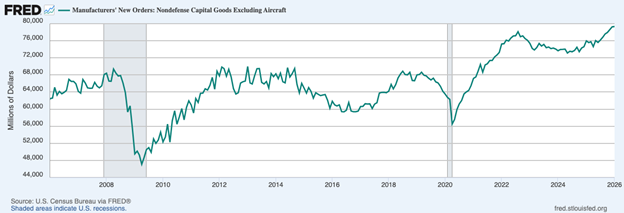
Business investment data tell a similar story. Manufacturers’ new orders for nondefense capital goods excluding aircraft (which is one of the cleaner indicators of business equipment demand) remain near recent highs. That is not what an economy on the verge of contraction typically looks like.
The earnings picture is also important here because corporate profits ultimately drive equity markets over time. According to our colleagues at Zacks Investment Research, total S&P 500 earnings for the first quarter of 2026 are expected to rise 12.0% from a year earlier on 8.6% higher revenues, following a 14% earnings increase on 9.1% higher revenues in the prior quarter. Even after the onset of Middle East tensions, estimates for the quarter and for full-year 2026 have remained positive, with revisions still moving in a favorable direction.
It is also worth remembering how different the market’s earnings mix is today than in past oil-shock periods. Energy now accounts for only about 4% of S&P 500 earnings, down from roughly 15% twenty years ago and nearly 30% in 1980. Technology, by contrast, is expected to grow earnings by 24.6% in the first quarter and remains the dominant growth engine for the index. Even excluding Technology, the rest of the S&P 500 is still expected to grow earnings by 5.5%.
I don’t mean to firmly imply that the economy is immune to an energy shock. If oil prices were to rise sharply and remain elevated—in my view, perhaps $130+ per barrel for several months—the impact on inflation and growth would likely become more pronounced. I’m not convinced that’s an outcome that the U.S. or other developed countries would tolerate for very long, but it’s also fair to say that these events are difficult to forecast.
Even still, the current backdrop looks materially different from the periods investors instinctively compare it to. The U.S. economy is less energy-intensive than it was in the 1970s. Domestic oil production is much higher, the labor market is largely stable, and balance sheets (household, corporate, and banking) are generally in strong shape.
Across major geopolitical events since 1950, markets have often experienced short-term volatility, but they have generally stabilized and moved higher in the months that followed as uncertainty faded and the economic damage proved more limited than feared. That does not make conflict bullish. It simply underscores that markets tend to respond more to the gap between expectations and reality than to the headlines themselves.
Bottom Line for Investors
Geopolitical events can create sharp market swings, especially when oil prices are involved. But volatility alone is not evidence of economic weakness. The latest data continue to show consumer demand, business investment, and earnings growth holding up reasonably well, even as energy markets react to the latest headlines.
If oil prices were to spike sharply from here and remain elevated for a sustained period, the risk would increase. But that is not the same as saying the economy is already rolling over. For now, the better reading is that markets are reacting to uncertainty while the underlying economic picture remains more resilient than the headlines suggest.
If that’s the case, the real advantage comes from staying focused on what the data is actually showing, not just how markets are reacting in the moment.
Our March Stock Market Outlook Report4 takes that deeper look, helping investors separate short-term volatility from underlying trends and better understand what to watch next.
Inside, you’ll find:
- Asset allocation guidelines for today’s market environment
- Expert forecasts for inflation, rates, and economic trends
- Industry tables and rankings to help you spot opportunities
- Buy-side and sell-side consensus insights at a glance
- And much more!
For investors with $500,000 or more, claim your complimentary report to understand how market shifts may create opportunities in the months ahead.
IT’S FREE. Download our latest March Stock Market Outlook Report4
Disclosure
2 Zacks Investment Management reserves the right to amend the terms or rescind the free-Stock Market Outlook Report offer at any time and for any reason at its discretion.
3 Fred Economic Data. March 18, 2026. https://fred.stlouisfed.org/series/DGORDER
4 Zacks Investment Management reserves the right to amend the terms or rescind the free-Stock Market Outlook Report offer at any time and for any reason at its discretion.
DISCLOSURE
Past performance is no guarantee of future results. Inherent in any investment is the potential for loss.
Zacks Investment Management, Inc. is a wholly-owned subsidiary of Zacks Investment Research. Zacks Investment Management is an independent Registered Investment Advisory firm and acts as an investment manager for individuals and institutions. Zacks Investment Research is a provider of earnings data and other financial data to institutions and to individuals.
This material is being provided for informational purposes only and nothing herein constitutes investment, legal, accounting or tax advice, or a recommendation to buy, sell or hold a security. Do not act or rely upon the information and advice given in this publication without seeking the services of competent and professional legal, tax, or accounting counsel. Publication and distribution of this article is not intended to create, and the information contained herein does not constitute, an attorney-client relationship. No recommendation or advice is being given as to whether any investment or strategy is suitable for a particular investor. It should not be assumed that any investments in securities, companies, sectors or markets identified and described were or will be profitable. All information is current as of the date of herein and is subject to change without notice. Any views or opinions expressed may not reflect those of the firm as a whole.
Any projections, targets, or estimates in this report are forward looking statements and are based on the firm’s research, analysis, and assumptions. Due to rapidly changing market conditions and the complexity of investment decisions, supplemental information and other sources may be required to make informed investment decisions based on your individual investment objectives and suitability specifications. All expressions of opinions are subject to change without notice. Clients should seek financial advice regarding the appropriateness of investing in any security or investment strategy discussed in this presentation.
Certain economic and market information contained herein has been obtained from published sources prepared by other parties. Zacks Investment Management does not assume any responsibility for the accuracy or completeness of such information. Further, no third party has assumed responsibility for independently verifying the information contained herein and accordingly no such persons make any representations with respect to the accuracy, completeness or reasonableness of the information provided herein. Unless otherwise indicated, market analysis and conclusions are based upon opinions or assumptions that Zacks Investment Management considers to be reasonable. Any investment inherently involves a high degree of risk, beyond any specific risks discussed herein.
The S&P 500 Index is a well-known, unmanaged index of the prices of 500 large-company common stocks, mainly blue-chip stocks, selected by Standard & Poor’s. The S&P 500 Index assumes reinvestment of dividends but does not reflect advisory fees. The volatility of the benchmark may be materially different from the individual performance obtained by a specific investor. An investor cannot invest directly in an index.
The Russell 2000 Index is a well-known, unmanaged index of the prices of 2000 small-cap company common stocks, selected by Russell. The Russell 2000 Index assumes reinvestment of dividends but does not reflect advisory fees. An investor cannot invest directly in an index. The volatility of the benchmark may be materially different from the individual performance obtained by a specific investor.