In this week’s Steady Investor, we break down how today’s market environment is impacting investor planning, including factors such as:
- Dollar slide impacts global markets
- Fed holds rates steady
- EU–India free trade deal
Is a Weaker U.S. Dollar a Problem for Investors? – The U.S. dollar has softened recently, raising understandable questions about what it means for the economy and markets. The media narratives swirled this week, but we’d like to cut through the noise by emphasizing a straightforward takeaway: the dollar is still relatively strong by historical standards, as seen in the chart below. The dollar’s recent move looks more like a pullback from elevated levels than a fundamental break in its role in the global system.1
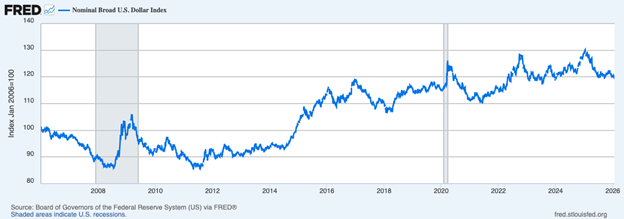
Source: Federal Reserve Bank of St. Louis2
How to Read the Market as Conditions Shift
Markets are becoming more demanding. Volatility is resurfacing unevenly, expectations are adjusting, and investors may be forced to confront risks that were easy to overlook during stronger market runs.
I recommend downloading our latest Stock Market Outlook Report¹, which examines what current data is signaling about potential pressure points, leadership changes, and where portfolios may need to adapt as conditions evolve.
Inside this report, we examine:
- Asset allocation guidelines for today’s market environment
- Expert forecasts for inflation, rates, and economic trends
- Industry tables and rankings to help you spot opportunities
- Buy-side and sell-side consensus insights at a glance
- And much more!
If you have $500,000 or more to invest, claim your complimentary copy of the report and see how shifting market trends could influence opportunities in the months ahead.
IT’S FREE. Download our latest Stock Market Outlook Report3
A second point to emphasize is just as important: the dollar moves in cycles. It strengthens and weakens over time as growth, interest-rate differentials, and global capital flows shift. Markets and the economy have proven capable of performing well in either environment. A stronger dollar can weigh on exporters and multinationals, but it also boosts purchasing power and can help dampen inflation. A weaker dollar can support exports and overseas earnings, while raising the cost of imports and some commodities. The effects are real, but they cut both ways. For investors, the key takeaway is perspective. Currency moves can influence which sectors benefit at the margin, but they don’t dictate market direction. History offers plenty of examples of strong equity performance during periods of both dollar strength and dollar weakness. That’s why the more durable drivers—earnings, economic growth, and financial conditions—tend to matter far more than day-to-day currency moves.
Rate Cuts are on Hold. Now What? – The Federal Reserve held interest rates steady this week and gave little indication that future rate cuts are imminent. The decision to keep the federal-funds rate in a 3.5%–3.75% range was widely expected and barely moved markets, underscoring how comfortable investors have become with the Fed’s current holding pattern.
Fed Chair Jerome Powell said recent data have modestly improved since the last meeting, pointing to stronger economic growth and signs that the labor market has stabilized. While job growth has slowed over the past year, the unemployment rate has leveled off, reducing the urgency to provide additional support through lower rates. “We’re well positioned,” Powell said, signaling that officials are comfortable staying on hold until clearer evidence emerges, whether that’s renewed labor-market weakness or more convincing progress on inflation. Absent a major economic surprise, we think the next rate cut may not arrive until after Powell’s term as chair ends in May, especially given that economic growth is holding up better than many expected.4
A Major New Trade Deal Signals a Shift in the Global Economy – The U.S.’s recent tariff policies may give the impression that free trade is no longer a global priority. A deal between India and the European Union suggests otherwise. This week, India and the EU reached a landmark free-trade agreement, underscoring how global trade relationships are evolving as countries seek to reduce reliance on the U.S.Once finalized, the deal would link nearly two billion consumers and become the EU’s largest trade agreement by population. The agreement is part of a broader pattern. Over the past year, major U.S. trading partners have accelerated efforts to deepen ties with one another rather than wait for greater clarity from the U.S. The EU recently struck a trade deal with South America’s Mercosur bloc, while the U.K. has expanded agreements with India, South Korea, and the EU. Canada and China have also moved to lower tariffs on select goods.At its core, the EU–India deal aims to eliminate or reduce tariffs on most traded goods between the two economies. India is set to sharply lower tariffs on European machinery, chemicals, pharmaceuticals, and automobiles, while Europe will reduce duties on a range of Indian exports, including apparel, footwear, and other labor-intensive goods. While the pact still requires ratification and omits some areas of trade, it reflects a broader shift in the global trade landscape. Rather than a breakdown in globalization, the trend appears to be a reconfiguration: more regional and cross-regional agreements, fewer assumptions about U.S.-led trade frameworks, and greater diversification of economic partnerships.5
Developments like the EU–India trade deal highlight how the global economic landscape is changing. These shifts don’t stop at trade policy, but they influence markets, business decisions, and how investors position themselves.
To better understand what this means for markets today, our latest Stock Market Outlook Report⁶ examines the economic and earnings trends shaping investor behavior.
Inside the report, you’ll find:
- Asset allocation guidelines for today’s market environment
- Expert forecasts for inflation, rates, and economic trends
- Industry tables and rankings to help you spot opportunities
- Buy-side and sell-side consensus insights at a glance
- And much more!
If you have $500,000 or more to invest, claim your complimentary copy of the report and see how shifting market trends could influence opportunities in the months ahead.
IT’S FREE. Download our latest Stock Market Outlook Report6
Disclosure
2 Fred Economic Data. January 26, 2026. https://fred.stlouisfed.org/series/DTWEXBGS
3 Zacks Investment Management reserves the right to amend the terms or rescind the free-Stock Market Outlook Report offer at any time and for any reason at its discretion.
4 Wall Street Journal. January 28, 2026. https://www.wsj.com/economy/central-banking/fed-holds-rates-steady-for-first-time-since-july-e5622f03?mod=economy_lead_pos3
5 Wall Street Journal. January 27, 2026. https://www.wsj.com/economy/trade/eu-and-india-reach-free-trade-deal-as-world-responds-to-trump-tariffs-bbbdb8d2?mod=economy_feat2_trade_pos4
6 Zacks Investment Management reserves the right to amend the terms or rescind the free-Stock Market Outlook Report offer at any time and for any reason at its discretion.
DISCLOSURE
Past performance is no guarantee of future results. Inherent in any investment is the potential for loss.
Zacks Investment Management, Inc. is a wholly-owned subsidiary of Zacks Investment Research. Zacks Investment Management is an independent Registered Investment Advisory firm and acts as an investment manager for individuals and institutions. Zacks Investment Research is a provider of earnings data and other financial data to institutions and to individuals.
This material is being provided for informational purposes only and nothing herein constitutes investment, legal, accounting or tax advice, or a recommendation to buy, sell or hold a security. Do not act or rely upon the information and advice given in this publication without seeking the services of competent and professional legal, tax, or accounting counsel. Publication and distribution of this article is not intended to create, and the information contained herein does not constitute, an attorney-client relationship. No recommendation or advice is being given as to whether any investment or strategy is suitable for a particular investor. It should not be assumed that any investments in securities, companies, sectors or markets identified and described were or will be profitable. All information is current as of the date of herein and is subject to change without notice. Any views or opinions expressed may not reflect those of the firm as a whole.
Any projections, targets, or estimates in this report are forward looking statements and are based on the firm’s research, analysis, and assumptions. Due to rapidly changing market conditions and the complexity of investment decisions, supplemental information and other sources may be required to make informed investment decisions based on your individual investment objectives and suitability specifications. All expressions of opinions are subject to change without notice. Clients should seek financial advice regarding the appropriateness of investing in any security or investment strategy discussed in this presentation.
Certain economic and market information contained herein has been obtained from published sources prepared by other parties. Zacks Investment Management does not assume any responsibility for the accuracy or completeness of such information. Further, no third party has assumed responsibility for independently verifying the information contained herein and accordingly no such persons make any representations with respect to the accuracy, completeness or reasonableness of the information provided herein. Unless otherwise indicated, market analysis and conclusions are based upon opinions or assumptions that Zacks Investment Management considers to be reasonable. Any investment inherently involves a high degree of risk, beyond any specific risks discussed herein.
The S&P 500 Index is a well-known, unmanaged index of the prices of 500 large-company common stocks, mainly blue-chip stocks, selected by Standard & Poor’s. The S&P 500 Index assumes reinvestment of dividends but does not reflect advisory fees. The volatility of the benchmark may be materially different from the individual performance obtained by a specific investor. An investor cannot invest directly in an index.
The Russell 2000 Index is a well-known, unmanaged index of the prices of 2000 small-cap company common stocks, selected by Russell. The Russell 2000 Index assumes reinvestment of dividends but does not reflect advisory fees. An investor cannot invest directly in an index. The volatility of the benchmark may be materially different from the individual performance obtained by a specific investor.