Small-Caps, Diversification, and the Broadening Market Rally
For the financial media and the broad investor community, the overwhelming focus over the past year has been on mega-cap technology stocks. But that has meant overlooking a more interesting story, in my view—the strong performance of small-cap stocks.
With little fanfare, the Russell 2000 index of small-cap stocks has outperformed the S&P 500 index in the second quarter and over the past year, by a fairly significant margin in both periods. For a segment of the market that spent several years lagging large-cap stocks, this marks a meaningful shift.
There are a few reasons for the recent strength, in my view. The first is valuation. As small-caps entered 2026 following a stretch of underperformance versus large-caps, the asset class was trading at a meaningful discount. As seen in the relative valuation chart below, the Russell 2000 trades at its cheapest level relative to the Russell 1000 in 25 years.
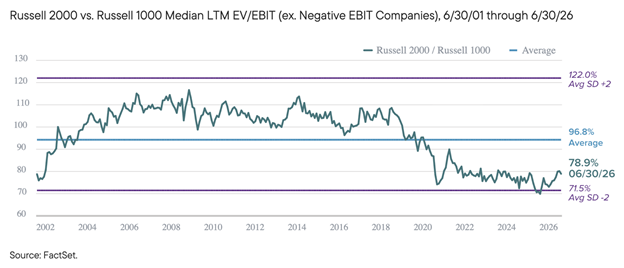
Cheap valuations alone are never enough to support a lasting rally, but they can create a more attractive starting point when fundamentals improve—which they did.
Consensus expectations for Russell 2000 earnings growth have risen to 38% from roughly 23% at the start of the year. Large-caps have also seen nicely positive revisions to earnings estimates, but not by a factor of nearly two. As such, not only did small-caps get cheaper relative to large-caps, they also saw more dramatic improvement in profit expectations. That’s a formula for outperformance.
The third driver behind strong small-cap performance is the broadening of the artificial intelligence investment cycle. AI is often discussed as a mega-cap technology story, but the buildout of data centers, computing infrastructure, power systems, industrial equipment, and semiconductor supply chains reaches well beyond the largest companies. Smaller suppliers have also benefited, with AI infrastructure stocks contributing roughly 40% of the Russell 2000’s year-to-date return through mid-2026.
Investors may be wondering if this means that small-caps may be the next asset class with a ‘concentration problem,’ i.e., a handful of stocks driving overall index returns. That’s on our radar, too, but we also know that small-cap indexes contain a wide range of companies—profitable businesses with strong balance sheets, earlier-stage firms still scaling, niche industrial suppliers, regional banks, healthcare and biotech companies, technology hardware firms, and many others. Selection is key.
The more important point here, however, is remembering the role small-caps can play in a portfolio over time. Large-cap stocks may provide exposure to global market leaders, strong balance sheets, and dominant franchises. Small-caps can add exposure to earlier-stage growth, domestic economic momentum, innovation, acquisition targets, and companies with more room to expand from a smaller base. For growth-oriented equity investors, that can be a valuable asset.
Bottom Line for Investors
Small-cap performance may be sending a constructive signal to the broader equity landscape, suggesting that the market rally may be broadening. When more areas of the market begin participating, it can point to improving confidence in the broader economy and a more balanced set of opportunities. That’s a good thing, in my view.
After several years of large-cap dominance, stronger small-cap performance suggests investors are finding opportunity in a wider range of companies, sectors, and earnings drivers. That does not eliminate the risks tied to rates, credit conditions, or earnings volatility, but it does make the rally look less dependent on a narrow group of mega-cap leaders and more reflective of improving confidence across the broader equity market.
Disclosure
Past performance is no guarantee of future results. Inherent in any investment is the potential for loss.
Zacks Investment Management, Inc. is a wholly-owned subsidiary of Zacks Investment Research. Zacks Investment Management is an independent Registered Investment Advisory firm and acts as an investment manager for individuals and institutions. Zacks Investment Research is a provider of earnings data and other financial data to institutions and to individuals.
This material is being provided for informational purposes only and nothing herein constitutes investment, legal, accounting or tax advice, or a recommendation to buy, sell or hold a security. Do not act or rely upon the information and advice given in this publication without seeking the services of competent and professional legal, tax, or accounting counsel. Publication and distribution of this article is not intended to create, and the information contained herein does not constitute, an attorney-client relationship. No recommendation or advice is being given as to whether any investment or strategy is suitable for a particular investor. It should not be assumed that any investments in securities, companies, sectors or markets identified and described were or will be profitable. All information is current as of the date of herein and is subject to change without notice. Any views or opinions expressed may not reflect those of the firm as a whole.
Any projections, targets, or estimates in this report are forward looking statements and are based on the firm’s research, analysis, and assumptions. Due to rapidly changing market conditions and the complexity of investment decisions, supplemental information and other sources may be required to make informed investment decisions based on your individual investment objectives and suitability specifications. All expressions of opinions are subject to change without notice. Clients should seek financial advice regarding the appropriateness of investing in any security or investment strategy discussed in this presentation.
Certain economic and market information contained herein has been obtained from published sources prepared by other parties. Zacks Investment Management does not assume any responsibility for the accuracy or completeness of such information. Further, no third party has assumed responsibility for independently verifying the information contained herein and accordingly no such persons make any representations with respect to the accuracy, completeness or reasonableness of the information provided herein. Unless otherwise indicated, market analysis and conclusions are based upon opinions or assumptions that Zacks Investment Management considers to be reasonable. Any investment inherently involves a high degree of risk, beyond any specific risks discussed herein.
The S&P 500 Index is a well-known, unmanaged index of the prices of 500 large-company common stocks, mainly blue-chip stocks, selected by Standard & Poor’s. The S&P 500 Index assumes reinvestment of dividends but does not reflect advisory fees. The volatility of the benchmark may be materially different from the individual performance obtained by a specific investor. An investor cannot invest directly in an index.
The Russell 2000 Index is a well-known, unmanaged index of the prices of 2000 small-cap company common stocks, selected by Russell. The Russell 2000 Index assumes reinvestment of dividends but does not reflect advisory fees. An investor cannot invest directly in an index. The volatility of the benchmark may be materially different from the individual performance obtained by a specific investor.
The Nasdaq Composite Index measures all Nasdaq domestic and international based common type stocks listed on The Nasdaq Stock Market. To be eligible for inclusion in the Index, the security's U.S. listing must be exclusively on The Nasdaq Stock Market (unless the security was dually listed on another U.S. market prior to January 1, 2004 and has continuously maintained such listing). The security types eligible for the Index include common stocks, ordinary shares, ADRs, shares of beneficial interest or limited partnership interests and tracking stocks. Security types not included in the Index are closed-end funds, convertible debentures, exchange traded funds, preferred stocks, rights, warrants, units and other derivative securities. An investor cannot invest directly in an index.