Markets Do Not Panic Over Every Conflict—Investors Shouldn’t Either
The headlines coming out of the Middle East this week are unsettling. Investors are undoubtedly wondering how ongoing military strikes, retaliatory attacks, threats of wider escalation, and shocks to energy markets could impact the global economy. These are all valid concerns, and I empathize with the uncertainty many readers are likely experiencing.
But when we step back and analyze events strictly through a market lens—which is our job here at Zacks—history shows something important: regional conflicts rarely alter the long-term trajectory of global markets, unless they materially disrupt global economic activity.1
As ever, history is the most useful guide we have in these situations. Over the last 75+ years, there is ample evidence to show that regional wars and geopolitical flare-ups have no consistent relationship with recessions or prolonged bear markets. Markets often experience short-term volatility in the run-up to and immediate aftermath of conflict, which investors should expect to see in the coming days and weeks.
Navigating Market Volatility in this Uncertain Market
Headlines about conflicts can spike short-term volatility and make it tempting to react. But the real focus for investors is understanding how these events affect markets and your portfolio. The key is staying disciplined, managing risk, and keeping your long-term plan on track.
Navigating Market Volatility2 is a free guide that helps investors step back, evaluate risk, and make clear-headed decisions when headlines create uncertainty. Download it to learn:
- Sharp market declines and corrections are a normal part of investing
- The best market days come unexpectedly (often within days or weeks of the worst days)
- Trying to pick market tops and bottoms is nearly impossible
- Trust your strategy and discipline, not the headlines
- Plus, more insights and assistance to help you keep your investment strategy on course
If you have $500,000 or more to invest, get your free volatility guide today!
Download Your Free Copy Today: Navigating Market Volatility: 4 Principles for Staying the Course2
But once markets assess the scope and economic reach of the conflict, equities tend to refocus on fundamentals.
Indeed, in modern market history, only World War II independently caused a sustained bear market by materially impairing a significant portion of global productive capacity. More recent conflicts—including the Iraq wars, the Bosnian War, the Gulf War, the Syrian civil war, and the recent Gaza War—produced volatility, but markets ultimately moved on once the economic transmission channels became clearer. One exception may be the Russia-Ukraine war, but that conflict collided with a post-Covid supply chain crisis, soaring inflation, and rapidly rising interest rates. We’re not seeing those types of conditions today.
In the current situation, perhaps the biggest investor focus is on energy markets. Oil is the most immediate economic variable, since roughly 20 million barrels per day (about 20% of global oil production) move through the Strait of Hormuz. To be fair, a meaningful or prolonged disruption there would have implications for inflation, corporate margins, and consumer spending. It’s a factor to watch.
Brent crude prices are on the rise (chart below), but as I write, prices remain well within the range seen over the past several years. Remember, from 2011 through 2014, Brent traded above $110 per barrel for an extended period, during years that coincided with economic expansion and a rising equity market. Rising oil prices alone are not automatically a harbinger for recession.
Global Price of Brent Crude, 2003 – Present
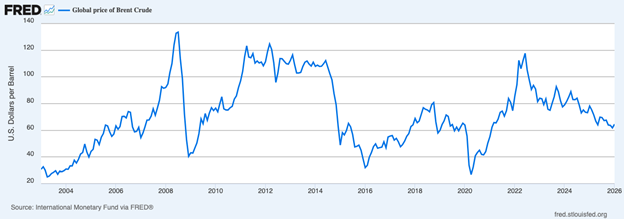
What matters is duration and scale. A temporary spike driven by uncertainty is very different from a sustained supply shock that meaningfully removes production from the global system. And so far, energy markets are not behaving as though investors expect a prolonged shutdown of supply.
This could change, of course, and we’ll be watching closely. But it’s also true that the Strait of Hormuz has not been seriously closed since the 1980s, even during periods of heavy regional fighting. Despite recurring fears over the decades, oil shipments have largely continued to flow. Energy markets are adaptive—producers adjust output, shipping routes can be rerouted where possible, strategic reserves can be deployed, and high prices themselves encourage additional supply.
Natural gas adds another dimension to the energy discussion, particularly for Europe and Asia. In 2022, when Europe scrambled to replace Russian pipeline gas, benchmark European natural gas prices soared to extraordinary levels amid fears of winter shortages. That spike was driven not just by conflict, but by a sudden structural loss of supply combined with low storage levels heading into heating season.
Today’s environment looks materially different.
While recent attacks have temporarily raised concerns around LNG production in parts of the Gulf region, global gas inventories are not in the same fragile position they were three years ago. Europe has diversified supply sources, expanded LNG import capacity, and improved storage buffers. Prices have moved higher in response to uncertainty, but they remain far below the extreme levels reached during the 2022 energy crisis.
Importantly, U.S. natural gas prices, which are often a useful barometer of global LNG tightness, have not exhibited the kind of surge typically associated with a sustained global shortage. That suggests markets are pricing risk, not permanent supply destruction. We’re also moving out of winter, which could be an important demand factor.
Could energy prices move higher from here? Certainly. Markets will continue to incorporate new information as the situation evolves. But for this conflict to meaningfully alter the economic trajectory, disruptions would need to be large, sustained, and broad enough to materially impair global demand. That is a high threshold, and I don’t think investors should act as though it’s a foregone conclusion.
Volatility in response to geopolitical events is normal. It has been a feature of markets for decades. The key distinction investors must make is between unsettling headlines and structural economic damage. And at this stage, I do not see evidence of the latter.
Bottom Line for Investors
The situation in Iran deserves close monitoring, particularly in energy markets. Oil, and to a lesser extent, natural gas, are the primary economic variables to watch. If prices spike sharply and remain elevated, volatility could persist.
But history suggests that regional conflicts tend to produce temporary market disruptions rather than lasting bear markets. The broader economic backdrop of moderating inflation, resilient labor markets, steady earnings growth, and improving market breadth remains intact. Those forces tend to drive longer-term market direction far more than regional conflicts, unless the conflict fundamentally alters global production or consumption patterns. We’re pretty far from that outcome today, in my view.
Markets can swing fast when headlines hit, but reacting on impulse can cost you. During these turbulent times, I recommend downloading our guide, Navigating Market Volatility4. It shows investors how to stay steady, manage risk, and protect income when markets move sharply.
Inside, you’ll also learn how to:
- Sharp market declines and corrections are a normal part of investing
- The best market days come unexpectedly (often within days or weeks of the worst days)
- Trying to pick market tops and bottoms is nearly impossible
- Trust your strategy and discipline, not the headlines
- Plus, more insights and assistance to help you keep your investment strategy on course
If you have $500,000 or more to invest, access your free volatility guide today.
Disclosure
2 Zacks Investment Management reserves the right to amend the terms or rescind the free Navigating Market Volatility: 4 Principles for Staying the Course offer at any time and for any reason at its discretion.
3 Fred Economic Data. February 12, 2026. https://fred.stlouisfed.org/series/POILBREUSDM
4 Zacks Investment Management reserves the right to amend the terms or rescind the free Navigating Market Volatility: 4 Principles for Staying the Course offer at any time and for any reason at its discretion.
DISCLOSURE
Past performance is no guarantee of future results. Inherent in any investment is the potential for loss.
Zacks Investment Management, Inc. is a wholly-owned subsidiary of Zacks Investment Research. Zacks Investment Management is an independent Registered Investment Advisory firm and acts as an investment manager for individuals and institutions. Zacks Investment Research is a provider of earnings data and other financial data to institutions and to individuals.
This material is being provided for informational purposes only and nothing herein constitutes investment, legal, accounting or tax advice, or a recommendation to buy, sell or hold a security. Do not act or rely upon the information and advice given in this publication without seeking the services of competent and professional legal, tax, or accounting counsel. Publication and distribution of this article is not intended to create, and the information contained herein does not constitute, an attorney-client relationship. No recommendation or advice is being given as to whether any investment or strategy is suitable for a particular investor. It should not be assumed that any investments in securities, companies, sectors or markets identified and described were or will be profitable. All information is current as of the date of herein and is subject to change without notice. Any views or opinions expressed may not reflect those of the firm as a whole.
Any projections, targets, or estimates in this report are forward looking statements and are based on the firm’s research, analysis, and assumptions. Due to rapidly changing market conditions and the complexity of investment decisions, supplemental information and other sources may be required to make informed investment decisions based on your individual investment objectives and suitability specifications. All expressions of opinions are subject to change without notice. Clients should seek financial advice regarding the appropriateness of investing in any security or investment strategy discussed in this presentation.
Certain economic and market information contained herein has been obtained from published sources prepared by other parties. Zacks Investment Management does not assume any responsibility for the accuracy or completeness of such information. Further, no third party has assumed responsibility for independently verifying the information contained herein and accordingly no such persons make any representations with respect to the accuracy, completeness or reasonableness of the information provided herein. Unless otherwise indicated, market analysis and conclusions are based upon opinions or assumptions that Zacks Investment Management considers to be reasonable. Any investment inherently involves a high degree of risk, beyond any specific risks discussed herein.
It is not possible to invest directly in an index. Investors pursuing a strategy similar to an index may experience higher or lower returns, which will be reduced by fees and expenses.
The S&P 500 Index is a well-known, unmanaged index of the prices of 500 large-company common stocks, mainly blue-chip stocks, selected by Standard & Poor’s. The S&P 500 Index assumes reinvestment of dividends but does not reflect advisory fees. The volatility of the benchmark may be materially different from the individual performance obtained by a specific investor. An investor cannot invest directly in an index.
The Russell 1000 Growth Index is a well-known, unmanaged index of the prices of 1000 large-company growth common stocks selected by Russell. The Russell 1000 Growth Index assumes reinvestment of dividends but does not reflect advisory fees. An investor cannot invest directly in an index. The volatility of the benchmark may be materially different from the individual performance obtained by a specific investor.
Nasdaq Composite Index is the market capitalization-weighted index of over 3,300 common equities listed on the Nasdaq stock exchange. The types of securities in the index include American depositary receipts, common stocks, real estate investment trusts (REITs) and tracking stocks, as well as limited partnership interests. The index includes all Nasdaq-listed stocks that are not derivatives, preferred shares, funds, exchange-traded funds (ETFs) or debenture securities. An investor cannot invest directly in an index. The volatility of the benchmark may be materially different from the individual performance obtained by a specific investor.
“The Dow Jones Industrial Average measures the daily stock market movements of 30 U.S. publicly-traded companies listed on the NASDAQ or the New York Stock Exchange (NYSE). The 30 publicly-owned companies are considered leaders in the United States economy. An investor cannot directly invest in an index. The volatility of the benchmark may be materially different from the individual performance obtained by a specific investor.”
Returns for each strategy and the corresponding Morningstar Universe reflect the annualized returns for the periods indicated. The Morningstar Universes used for comparative analysis are constructed by Morningstar (median performance) and data is provided to Zacks by Zephyr Style Advisor. The percentile ranking for each Zacks Strategy is based on the gross comparison for Zacks Strategies vs. the indicated universe rounded up to the nearest whole percentile. Other managers included in universe by Morningstar may exhibit style drift when compared to Zacks Investment Management portfolio. Neither Zacks Investment Management nor Zacks Investment Research has any affiliation with Morningstar. Neither Zacks Investment Management nor Zacks Investment Research had any influence of the process Morningstar used to determine this ranking.