In today’s Steady Investor, we cover three developments influencing the market landscape and what they could mean for investors, including:
- U.S. jobs market stays resilient
- Corporate borrowing remains strong
- Oil volatility returns to focus
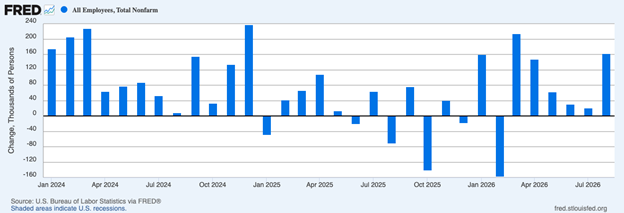
The U.S. Jobs Market Remains Resilient – August’s jobs report helped ease concerns that the labor market was slipping into a deeper slowdown. The U.S. economy added 162,000 jobs, well above expectations, while the unemployment rate held steady at 4.1%.1
Total Nonfarm Payroll (Changes in Thousands of Persons, January 2024 – Present)
Is Your Retirement Plan Built for Changing Conditions?
A strong retirement plan isn’t built around predicting exactly what markets, inflation, or interest rates will do next. It’s built to help you stay prepared as conditions change.
Our free guide, 8 Steps Towards a Stress-Free Retirement3, covers key considerations for building a more resilient retirement strategy, including:
- How to plan for emergencies that can derail your retirement investments
- Why missing just 25 trading days can decimate your returns
- Three ways to generate income during retirement
- Plus, other key steps to help you realize your retirement goals
Want to feel more prepared for whatever retirement brings?
Download 8 Steps Towards a Stress-Free Retirement3 to learn practical steps for building a strategy designed for the long term.
Labor force participation also ticked up to 61.6%, its first monthly increase since last September.The prior two months looked better after revisions, too. July was revised from a loss of -23,000 jobs to a gain of 21,000, while June was revised up to 31,000. Altogether, the economy has added an average of about 80,000 jobs per month so far this year, a clear improvement from 2025’s average of 10,000.That all being said, investors should not assume the jobs market is on completely solid footing. Some of August’s strength came from likely one-off rebounds, including 59,000 jobs added in food services and drinking places and 42,000 in local government education. Wage growth also remains a pressure point, with average hourly earnings up 3.1% from a year earlier, slightly below July’s 3.4% inflation rate. We’ve written this before, but perhaps the most apt description for the U.S. jobs market is “low hire, low fire,” where layoffs are limited but hiring and job switching remain subdued. Overall, we think the labor market looks healthier than it did earlier this summer, but payrolls are still lagging.
Corporate Borrowing Shows Credit Markets Are Still Open – Companies are moving quickly to raise money in global bond markets, a sign that higher interest rates and geopolitical uncertainty are influencing corporate financing decisions. This past Tuesday, global borrowers raised more than $70 billion, the busiest issuance day since June, as companies were clearly looking to lock in funding before borrowing costs potentially move higher. Investors are of course very cognizant of renewed U.S.-Iran tensions, rising oil prices, stubborn inflation, and the possibility that the Federal Reserve could raise rates later this month.Even still, investors are clearly comfortable lending in the current rate environment. In the U.S. high-grade market, investor demand was roughly four times the amount of bonds sold, according to Bloomberg data. Issuers were also able to price deals with relatively limited extra spread compared with their existing debt, suggesting buyers are still willing to provide capital at reasonable terms.Heavy issuance does not guarantee future growth, but it does suggest the market is not shutting companies out.4
Oil Volatility Moves Back Into Focus – Oil prices moved back above $100 a barrel this week, as renewed fighting in the Middle East raised fresh concerns about shipping and supply disruptions. As we write, Brent crude rose 4.1% to $105.37, while WTI climbed 4.3% to $100.13, putting both benchmarks back near levels last seen earlier this year.The concern is not just the price move itself, but the pressure on physical energy flows. The Strait of Hormuz normally carries about one-fifth of global petroleum shipments, but analysts estimate current flows remain far below prewar levels. HSBC expects shipments through Hormuz to rise from roughly 6 million barrels a day now to 8 million by year-end and 9.5 million by mid-2027—still well below the prewar range of 19 million to 20 million barrels a day.Other data point to similar strain. Middle East Gulf sour-crude exports averaged 5.88 million barrels a day in the second quarter, down 65% from a year earlier. The EIA estimates Middle East production shut-ins averaged 6.7 million barrels a day in August and could still average 5.7 million in the fourth quarter.Taken together, we think some of today’s price reflects physical disruption, while some reflects fear and positioning. The key question is whether supply flows continue improving, or whether renewed conflict keeps energy markets tight for longer.5
Take the Next Step Toward a More Confident Retirement – Market swings can be unsettling at any stage, but they can feel especially significant when you’re relying on your portfolio for retirement income. Having a plan for navigating those periods can help you stay focused on your long-term goals.
Our complimentary report, 8 Steps Towards a Stress-Free Retirement6, explores practical strategies to help you prepare, including:
- How to plan for emergencies that can derail your retirement investments
- Why missing just 25 trading days can decimate your returns
- Three ways to generate income during retirement
- Plus, other key steps to help you realize your retirement goals
Download 8 Steps Towards a Stress-Free Retirement3 to learn practical steps for building a strategy designed for the long term.
Disclosure
2 FRED, Federal Reserve Bank of St. Louis. Current Employment Statistics (Establishment Survey). All Employees, Total Nonfarm.
3 Zacks Investment Management may amend or rescind the “8 Steps Towards a Stress-Free Retirement” guide for any reason and at ZIM’s discretion.
4 The Edge Singapore. September 9, 2026. https://www.theedgesingapore.com/news/global-economy/global-credit-market-revs-again-after-us70-bil-issuance
5 Wall Street Journal. September 7, 2026. https://www.wsj.com/finance/stocks/oil-rises-as-escalating-u-s-iran-conflict-stokes-supply-disruption-fears-acdef1ab?mod=wsj_furtherreading_pos_1
6 Zacks Investment Management may amend or rescind the “8 Steps Towards a Stress-Free Retirement” guide for any reason and at ZIM’s discretion.
DISCLOSURE
Past performance is no guarantee of future results. Inherent in any investment is the potential for loss.
Zacks Investment Management, Inc. is a wholly-owned subsidiary of Zacks Investment Research. Zacks Investment Management is an independent Registered Investment Advisory firm and acts as an investment manager for individuals and institutions. Zacks Investment Research is a provider of earnings data and other financial data to institutions and to individuals.
This material is being provided for informational purposes only and nothing herein constitutes investment, legal, accounting or tax advice, or a recommendation to buy, sell or hold a security. Do not act or rely upon the information and advice given in this publication without seeking the services of competent and professional legal, tax, or accounting counsel. Publication and distribution of this article is not intended to create, and the information contained herein does not constitute, an attorney-client relationship. No recommendation or advice is being given as to whether any investment or strategy is suitable for a particular investor. It should not be assumed that any investments in securities, companies, sectors or markets identified and described were or will be profitable. All information is current as of the date of herein and is subject to change without notice. Any views or opinions expressed may not reflect those of the firm as a whole.
Any projections, targets, or estimates in this report are forward looking statements and are based on the firm's research, analysis, and assumptions. Due to rapidly changing market conditions and the complexity of investment decisions, supplemental information and other sources may be required to make informed investment decisions based on your individual investment objectives and suitability specifications. All expressions of opinions are subject to change without notice. Clients should seek financial advice regarding the appropriateness of investing in any security or investment strategy discussed in this presentation.
Certain economic and market information contained herein has been obtained from published sources prepared by other parties. Zacks Investment Management does not assume any responsibility for the accuracy or completeness of such information. Further, no third party has assumed responsibility for independently verifying the information contained herein and accordingly no such persons make any representations with respect to the accuracy, completeness or reasonableness of the information provided herein. Unless otherwise indicated, market analysis and conclusions are based upon opinions or assumptions that Zacks Investment Management considers to be reasonable. Any investment inherently involves a high degree of risk, beyond any specific risks discussed herein.
The S&P 500 Index is a well-known, unmanaged index of the prices of 500 large-company common stocks, mainly blue-chip stocks, selected by Standard & Poor's. The S&P 500 Index assumes reinvestment of dividends but does not reflect advisory fees. The volatility of the benchmark may be materially different from the individual performance obtained by a specific investor. An investor cannot invest directly in an index.
Questions posed are for demonstrative and informational purposes only and may not reflect the views of current clients or any one individual.