On the Growing Concern Over U.S. Debt
Readers probably caught the headline last week: the U.S. national debt officially crossed the $40 trillion mark. If it feels like you’ve lost track of how big the number has gotten, you’re not alone.
The fact that total federal debt crossed $40 trillion is symbolically important. And it’s true the federal government continues running large deficits during an economic expansion, which has arguably contributed to rising long-term Treasury yields. These are all issues to keep on our radar.
But I also think investors should be careful about focusing only on the $40 trillion headline number and framing it in their minds as a debt problem where the danger to markets and the economy is imminent. Large numbers can create alarm, but they do not always tell us whether a debt burden is becoming immediately unmanageable.
What Could an Uncertain Rate Environment Mean for Your Portfolio?
With U.S. debt continuing to rise and long-term Treasury yields remaining elevated, the path forward for interest rates remains an important consideration for investors.
Our guide, Bond Ladders in an Uncertain Interest Rate Environment1, explores a fixed-income strategy designed to help investors manage interest rate risk without having to predict where rates will move next.
Inside, you’ll learn:
- What bond ladders are and how they work
- How to construct and manage a bond ladder
- The pros and cons of a laddered approach
- Plus, more insights to help you manage fixed income in a shifting rate environment
If you have $500,000 or more to invest, request your free copy today.
IT’S FREE. Download Bond Ladders in an Uncertain Interest Rate Environment1
In my view, the better way to analyze federal debt is to focus on debt-service capacity. In plain English, this means asking how much of the government’s revenue is needed just to pay interest on the debt.
This metric matters because interest expense competes with other priorities. Every dollar used for interest is a dollar that cannot be used as easily for defense, infrastructure, healthcare, entitlement programs, tax relief, or future investment. As it stands today, the issue is not whether the U.S. can make its next interest payment—it’s whether rising interest costs gradually reduce the government’s ability to stimulate the economy in other ways.
Interest costs as a share of federal tax receipts have risen meaningfully in recent years, which is a real concern. But they remain below the peaks reached in the 1980s and early 1990s, when interest rates and fiscal concerns were also elevated. Federal tax receipts also still exceed interest payments by a wide margin (chart below), which is one reason markets are not treating U.S. debt as a near-term solvency issue.
Federal tax receipts (blue line) vs. Federal interest payments (green line)
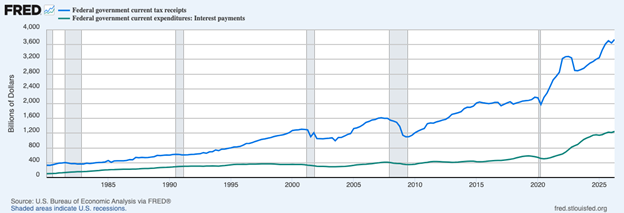
I think it’s fair to say, however, that the margin for error is narrowing. Put simply, the U.S. should not run large deficits indefinitely and assume the bond market will absorb every new dollar of debt at whatever yield policymakers prefer. The bond market has recently been reminding investors of this latter point.
If the $40 trillion milestone matters, this is why. It is not about imminent crisis—it’s about higher debt and higher rates leaving less room for error, and making sustained economic growth increasingly important.
The U.S. has carried high debt burdens before, most notably after World War II. What helped reduce that burden over time was not simply austerity or aggressive debt repayment. It was growth, productivity, inflation, and time. A growing economy makes a large debt burden easier to manage, while a slowing economy makes it harder.
For now, the U.S. continues to see economic growth, resilient corporate earnings, and strong demand for Treasury securities. Those conditions do not erase the debt problem, but they do help explain why markets are not treating $40 trillion as a breaking point.
The risk is that this balance becomes harder to maintain over time. If interest costs keep rising faster than tax receipts, policymakers may face tougher trade-offs around spending, taxes, and future investment. That is the part of the story investors should watch most closely. Not necessarily the headline debt number by itself, but whether the economy remains strong enough to carry the burden.
Bottom Line for Investors
The U.S. crossing $40 trillion in debt is a serious milestone, and investors are right to pay attention. But the better focal point, in my view, is whether the U.S. can continue servicing its debt while maintaining enough flexibility to support growth and respond to future challenges.
For now, the evidence still points to a long-term sustainability issue, not a near-term solvency crisis.
Meanwhile, the path of interest rates remains uncertain. Rather than trying to predict where rates will move next, investors may want to consider strategies designed to navigate a range of interest rate environments.
Our guide, Bond Ladders in an Uncertain Interest Rate Environment3, explores how bond ladders can help investors manage interest rate risk while providing a potentially predictable source of income.
Inside, you’ll learn:
- What bond ladders are and how they work
- How to construct and manage a bond ladder
- The pros and cons of a laddered approach
- Plus, more insights to help you manage fixed income in a shifting rate environment
If you have $500,000 or more to invest, request your free copy today
IT’S FREE. Download Bond Ladders in an Uncertain Interest Rate Environment3
Disclosure
Zacks Investment Management, Inc. is a wholly-owned subsidiary of Zacks Investment Research. Zacks Investment Management is an independent Registered Investment Advisory firm and acts an investment manager for individuals and institutions. Zacks Investment Research is a provider of earnings data and other financial data to institutions and to individuals.
This material is being provided for informational purposes only and nothing herein constitutes investment, legal, accounting or tax advice, or a recommendation to buy, sell or hold a security. Do not act or rely upon the information and advice given in this publication without seeking the services of competent and professional legal, tax, or accounting counsel. The information contained herein has been obtained from sources believed to be reliable but we do not guarantee accuracy or completeness. Publication and distribution of this article is not intended to create, and the information contained herein does not constitute, an attorney-client relationship. No recommendation or advice is being given as to whether any investment or strategy is suitable for a particular investor. It should not be assumed that any investments in securities, companies, sectors or markets identified and described were or will be profitable. All information is current as of the date of herein and is subject to change without notice. Any views or opinions expressed may not reflect those of the firm as a whole.