Steady Investor Weekly
What could recent developments mean for your finances? This issue of Steady Investor takes a closer look at three topics to watch:
- Bond yields hit new highs
- Middle East oil exports recover
- AI could help save money
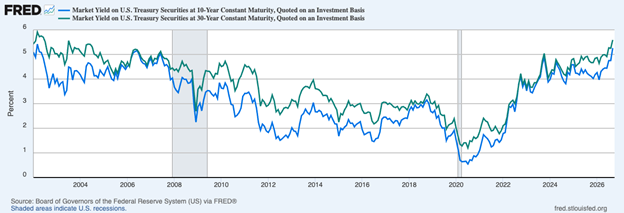
Bond Yields Keep Finding Their Way Back into the Headlines – Rising U.S. Treasury bond yields is a story that simply won’t go away. This week, the 10-year Treasury bond yield climbed above 5.3%, reaching its highest level in 24 years and capping a quarter in which it rose nearly 100 basis points. The 30-year Treasury bond yield has also moved to levels not seen in more than two decades.1
10-Year and 30-Year U.S. Treasury Bond Yields at Highest Levels Since 2002
Is Your Retirement Plan Keeping Up with Today’s Economy?
Shifting bond yields, changing energy costs, and overlooked financial opportunities can all affect your retirement strategy. Is your plan ready to adapt?
To help you navigate the current market, our free Crisis-Proof Retirement Guide2 is now available. It outlines practical steps to help strengthen your retirement strategy and prepare for the unexpected, including:
- How to diversify across time, tax treatment, and income sources
- Which overlooked risks pose the greatest threat to long-term security
- How to build flexibility into your withdrawal and investment approach
- Why annual reviews are essential for staying on course
- How a research-driven advisor can help reinforce durability
- And more…
Click the link below to download our free guide for strategies to help protect your retirement from market shocks and unexpected expenses.
Get our FREE guide: How to Build a Retirement Plan Designed for Uncertainty2
The forces pushing yields higher are familiar by now. Oil prices remain elevated amid the Iran conflict, inflation is still above the Fed’s 2% target, the economy has continued to grow, and heavy government and corporate borrowing has increased the supply of bonds investors are being asked to absorb. Many readers are familiar with the consumer effects of higher rates, in the form of higher mortgage and borrowing costs. But they can also crowd investors out of stocks, since a higher risk-free rate may look like an attractive alternative to a fully valued equity market. The key x-factor to keep front of mind, in our view, is that the broader U.S. economy has remained resilient despite all these pressures, and corporate earnings continue to surprise to the upside and support equities in the process.
Middle East Oil Flows are Finding a Way Through, Easing Pressure on Energy Markets – For much of this year, one of the biggest risks hanging over oil markets has been Iran’s ability to disrupt shipments through the Strait of Hormuz. But in an encouraging sign for global energy markets, recent data suggest Iran’s abilities are becoming less effective. Middle Eastern crude exports have rebounded to their highest level since the conflict began in February. By one estimate, regional exports are now running at just under 80% of prewar levels, helped by increased shipments from Saudi Arabia and the United Arab Emirates. Saudi Arabia has also resumed some flows through its repaired East-West pipeline, providing another route to global markets. To be sure, conditions are not fully back to normal. Exports are still lower, and alternative routes can also be slower, more expensive, and vulnerable to attack. Still, the improvement illustrates an important feature of commodity markets: high prices and supply disruptions create powerful incentives to adapt. Producers reroute shipments, repair infrastructure, and find new ways to get barrels to buyers.3
How AI Could Help Fix the “Laziness Tax” in Personal Finance – A news story about AI capabilities caught our attention this week, given its relation to personal finance. The application: an AI that could start helping people automatically identify, and fix, some of the small inefficiencies that quietly cost them money. There is plenty to work with. About $7.12 trillion currently sits in U.S. consumer and business checking accounts, according to Federal Reserve data, much of it earning little or no interest. AI tools could eventually sweep excess cash into higher-yielding accounts, flag unused subscriptions, remind users about bills, or identify opportunities to refinance debt.Mortgages offer one example. Morgan Stanley Research estimates AI could roughly double the share of borrowers who refinance or prepay their mortgages by continuously monitoring rates and preparing paperwork when savings become available. That kind of automation could help reduce what some call the “laziness tax,” or the money lost simply because people do not revisit financial decisions often enough. To be sure, AI is not a perfect solution. Recommendations can still be incomplete, biased, or influenced by commercial incentives, and consumers may not want software making every financial decision on their behalf. If reading this made you wonder whether there are similar inefficiencies in your own finances—and you are not comfortable relying on AI to find them—reach out to us. We can help review your cash, debt, fees, and other planning decisions for opportunities to improve.4
Strengthen Your Retirement Plan for What’s to Come – Could your retirement strategy hold up through a market downturn, higher living costs, or a major health expense? Now is a good time to assess where your plan may need more support.
Our free guide, Crisis-Proof Retirement Guide5, includes practical strategies to help protect your savings, strengthen your retirement plan, and prepare for the unexpected. Inside, you’ll learn:
- How to diversify across time, tax treatment, and income sources
- Which overlooked risks pose the greatest threat to long-term security
- How to build flexibility into your withdrawal and investment approach
- Why annual reviews are essential for staying on course
- How a research-driven advisor can help reinforce durability
- And more…
Download our free guide for strategies to help protect your retirement from market shocks and unexpected expenses.
Disclosure
2 Zacks Investment Management reserves the right to amend the terms or rescind the free How to Build a Retirement Plan Designed to Withstand Uncertainty offer at any time and for any reason at its discretion.
3 Wall Street Journal. September 28, 2026. “Middle East Oil Exports Rebound as Iran’s Chokehold on Hormuz Breaks Down.”
4 Wall Street Journal. September 24, 2026. “Lazy Customers Are Great for Banks. Could AI Change that?”
5 Zacks Investment Management reserves the right to amend the terms or rescind the free How to Build a Retirement Plan Designed to Withstand Uncertainty offer at any time and for any reason at its discretion.
DISCLOSURE
Past performance is no guarantee of future results. Inherent in any investment is the potential for loss.
Zacks Investment Management, Inc. is a wholly-owned subsidiary of Zacks Investment Research. Zacks Investment Management is an independent Registered Investment Advisory firm and acts as an investment manager for individuals and institutions. Zacks Investment Research is a provider of earnings data and other financial data to institutions and to individuals.
This material is being provided for informational purposes only and nothing herein constitutes investment, legal, accounting or tax advice, or a recommendation to buy, sell or hold a security. Do not act or rely upon the information and advice given in this publication without seeking the services of competent and professional legal, tax, or accounting counsel. Publication and distribution of this article is not intended to create, and the information contained herein does not constitute, an attorney-client relationship. No recommendation or advice is being given as to whether any investment or strategy is suitable for a particular investor. It should not be assumed that any investments in securities, companies, sectors or markets identified and described were or will be profitable. All information is current as of the date of herein and is subject to change without notice. Any views or opinions expressed may not reflect those of the firm as a whole.
Any projections, targets, or estimates in this report are forward looking statements and are based on the firm’s research, analysis, and assumptions. Due to rapidly changing market conditions and the complexity of investment decisions, supplemental information and other sources may be required to make informed investment decisions based on your individual investment objectives and suitability specifications. All expressions of opinions are subject to change without notice. Clients should seek financial advice regarding the appropriateness of investing in any security or investment strategy discussed in this presentation.
Certain economic and market information contained herein has been obtained from published sources prepared by other parties. Zacks Investment Management does not assume any responsibility for the accuracy or completeness of such information. Further, no third party has assumed responsibility for independently verifying the information contained herein and accordingly no such persons make any representations with respect to the accuracy, completeness or reasonableness of the information provided herein. Unless otherwise indicated, market analysis and conclusions are based upon opinions or assumptions that Zacks Investment Management considers to be reasonable.
The S&P 500 Index is a well-known, unmanaged index of the prices of 500 large-company common stocks, mainly blue-chip stocks, selected by Standard & Poor’s. The S&P 500 Index assumes reinvestment of dividends but does not reflect advisory fees. The volatility of the benchmark may be materially different from the individual performance obtained by a specific investor. An investor cannot invest directly in an index.
Any investment inherently involves a high degree of risk, beyond any specific risks discussed herein.
It is not possible to invest directly in an index. Investors pursuing a strategy similar to an index may experience higher or lower returns, which will be reduced by fees and expenses.