In today’s Steady Investor, we examine the forces behind the market’s recent resilience, and the risks that could challenge it in the months ahead, including:
- Slower growth, stronger earnings
- Tariff refunds face roadblocks
- Teen hiring hits record low
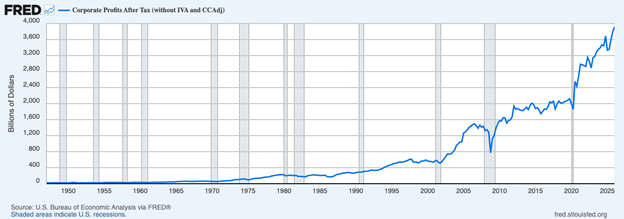
U.S. Economic Growth in Q1 2026 is Revised Lower, But Profits Made Up for It – The U.S. economy grew more slowly than initially estimated in the first quarter, according to updated government data released this week.The Bureau of Economic Analysis said that U.S. GDP rose at a 1.6% annualized rate in Q1, which was a step down from the previously reported 2% growth. The downward revision was driven largely by a weaker estimate for inventory investment, a volatile category that can swing meaningfully from one GDP report to the next. Consumer spending was also revised slightly lower, with overall spending rising at a 1.4% annualized rate versus the prior estimate of 1.6%. Spending on services, including healthcare, accounted for part of the downgrade.Even with the softer headline growth figure, the report was not uniformly weak. A key measure of corporate earnings, after-tax profits excluding inventory valuation and capital consumption adjustments (see chart below), rose 3.3% from the prior quarter and 17% from a year earlier. That marked the strongest year-over-year increase in corporate profits since the fourth quarter of 2021, and it tells us explicitly that businesses are experiencing solid earnings momentum despite a modest pace of economic expansion.1
Corporate Profits are Growing at a Brisk Pace
What Today’s Market Means for Your Portfolio
Markets continue to climb, but that doesn’t mean risks have disappeared. Beneath the market’s strength, investors are navigating a mix of economic, policy, and sentiment shifts that could shape what happens next.
Our free Zacks Market Strategy Report2 cuts through the noise and highlights the developments that may have the biggest impact on your portfolio in the months ahead. Read it today to learn what’s driving markets, and what investors should be watching closely, including:
- Inflation and its Impact on Consumers
- SEC May End Quarterly Earnings Report Requirement
- Record Earnings Expected for Q1 2026
- Bottom Line for Investors
If you have $500,000 or more, fill out the form to receive your free report today!
Download our complimentary Zacks Market Strategy Report3
A Tariff Refund Portal is Open, But Companies are Being Cautious – When the Supreme Court ruled the Trump administration tariffs were illegal, many expected there would be a flood of refund requests that could adversely impact the government’s fiscal situation. But that hasn’t happened. According to a Bloomberg analysis of the 3,000 largest publicly traded U.S. companies, only about 5% have mentioned tariff refunds in recent comments or regulatory filings. Companies face political scrutiny, uncertainty around timing, and possible legal risk from customers who argue that higher tariff-related prices should be refunded to consumers. Several large companies, including Nike, Lululemon, and Amazon, have already faced lawsuits related to the issue. There are also administrative hurdles, especially for companies with more complex import entries or claims that do not qualify for the first phase of refunds. This confluence of challenges has companies taking a more cautious approach to pursuing refunds, even as Customs and Border Protection has opened a refund portal for more than 330,000 firms that paid import taxes in recent months. In our view, the argument is not whether companies ultimately pursue refunds. Many will. It’s more a matter of timing, i.e., we are not likely to see a rush of requests because of the aforementioned issues. When all is said and done, however, the potential sums are significant. Bloomberg reported that among S&P 500 companies disclosing amounts, firms either paid or expect refunds tied to the tariffs totaling about $7.3 billion. More broadly, refunds could reach as much as $166 billion plus interest, with early filers already seeing billions of dollars returned. Refunds may support earnings in select sectors, yet the process involves enough legal, political, and administrative friction that investors should be careful not to treat the headline refund amount as an immediate or dollar-for-dollar boost to businesses or consumers.4
Is Your Teen Looking for a Summer Job? It’s a Tough Market – Summer jobs may be harder to find this year, particularly for teenagers looking for work at restaurants, camps, hotels, amusement parks, and other seasonal businesses.According to Challenger, Gray & Christmas, teens are projected to gain 790,000 jobs in May, June, and July. If that forecast proves accurate, it would mark the lowest summer hiring total for teens since the federal government began tracking the data in 1948. Last summer was already historically weak, with teen job gains falling more than 25% from the prior year to 801,000.One reason is that many of the businesses that traditionally hire teenagers are pulling back. Employers in the entertainment and leisure sector plan to fill 70% fewer roles than last year, according to Challenger. Indeed, data also shows summer camp counselor postings are down nearly 30% from a year ago, even as demand for some programs remains strong. For small businesses, the issue appears to be less about a lack of applicants and more about managing costs. Rising inflation and higher fuel prices are putting pressure on restaurants, resorts, and other seasonal employers, many of which are trying to avoid overstaffing. Overall employment conditions remain stable, but younger workers are facing a tougher entry point into the job market. For teens, summer work has long served as a first step toward building skills, earning income, and gaining experience. This year, those opportunities may be harder to come by.5
Navigating Today’s Market with Confidence – Not every market story is as straightforward as it appears. While headlines often focus on the latest developments, the real investment implications are often found beneath the surface.
Our free Zacks Market Strategy Report takes a deeper look at the economic and market trends shaping today’s investment environment. Inside, you’ll find perspective on the developments that could influence markets, businesses, and portfolios in the months ahead, including:
- Inflation and its Impact on Consumers
- SEC May End Quarterly Earnings Report Requirement
- Record Earnings Expected for Q1 2026
- Bottom Line for Investors
If you have $500,000 or more, fill out the form to receive your free report today!
Disclosure
2 Zacks Investment Management reserves the right to amend the terms or rescind the free Market Strategy Report offer at any time and for any reason at its discretion.
3 Fred Economic Data. May 28, 2026. https://fred.stlouisfed.org/series/CP
4 MSN. 2026. https://www.msn.com/en-us/money/savingandinvesting/us-companies-shamed-by-trump-tiptoe-into-a-tariff-refund-race/ar-AA23ThNr
5 Wall Street Journal. May 24, 2026. https://www.wsj.com/economy/teen-summer-jobs-f3ffdbfa?mod=economy_lead_pos4
6 Zacks Investment Management reserves the right to amend the terms or rescind the free Market Strategy Report offer at any time and for any reason at its discretion.
DISCLOSURE
Past performance is no guarantee of future results. Inherent in any investment is the potential for loss.
Zacks Investment Management, Inc. is a wholly-owned subsidiary of Zacks Investment Research. Zacks Investment Management is an independent Registered Investment Advisory firm and acts as an investment manager for individuals and institutions. Zacks Investment Research is a provider of earnings data and other financial data to institutions and to individuals.
This material is being provided for informational purposes only and nothing herein constitutes investment, legal, accounting or tax advice, or a recommendation to buy, sell or hold a security. Do not act or rely upon the information and advice given in this publication without seeking the services of competent and professional legal, tax, or accounting counsel. Publication and distribution of this article is not intended to create, and the information contained herein does not constitute, an attorney-client relationship. No recommendation or advice is being given as to whether any investment or strategy is suitable for a particular investor. It should not be assumed that any investments in securities, companies, sectors or markets identified and described were or will be profitable. All information is current as of the date of herein and is subject to change without notice. Any views or opinions expressed may not reflect those of the firm as a whole.
Any projections, targets, or estimates in this report are forward looking statements and are based on the firm’s research, analysis, and assumptions. Due to rapidly changing market conditions and the complexity of investment decisions, supplemental information and other sources may be required to make informed investment decisions based on your individual investment objectives and suitability specifications. All expressions of opinions are subject to change without notice. Clients should seek financial advice regarding the appropriateness of investing in any security or investment strategy discussed in this presentation.
Certain economic and market information contained herein has been obtained from published sources prepared by other parties. Zacks Investment Management does not assume any responsibility for the accuracy or completeness of such information. Further, no third party has assumed responsibility for independently verifying the information contained herein and accordingly no such persons make any representations with respect to the accuracy, completeness or reasonableness of the information provided herein. Unless otherwise indicated, market analysis and conclusions are based upon opinions or assumptions that Zacks Investment Management considers to be reasonable. Any investment inherently involves a high degree of risk, beyond any specific risks discussed herein.
The S&P 500 Index is a well-known, unmanaged index of the prices of 500 large-company common stocks, mainly blue-chip stocks, selected by Standard & Poor’s. The S&P 500 Index assumes reinvestment of dividends but does not reflect advisory fees. The volatility of the benchmark may be materially different from the individual performance obtained by a specific investor. An investor cannot invest directly in an index.