U.S. Households Are Feeling Some Strain. Why Don’t Markets Seem to Care?
According to the widely watched University of Michigan Consumer Sentiment Index, Americans are not feeling good about the economy.
The index fell to 44.8 in May, down from 49.8 in April, marking the lowest reading in the survey’s history dating back to 1952. That means consumer attitudes are now weaker than they were during the 2008 financial crisis, the pandemic recession, the inflation surge of 2022, and the recessions of the 1970s.1
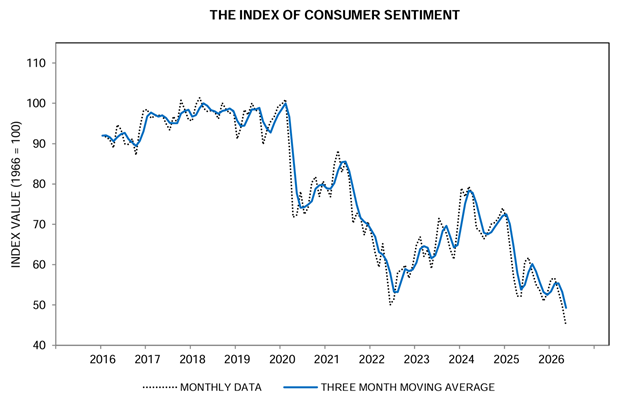
And yet the stock market is trading near all-time highs, having rallied off the lows at the start of the Iran conflict. For many investors, it can be puzzling to understand how a disconnect so large can exist.2
Why Markets Keep Climbing Despite Weak Consumer Sentiment
Consumer confidence is extremely weak right now, yet markets continue trading near record highs. For many investors, that disconnect can be difficult to understand.
Our latest Stock Market Outlook Report explores why markets and sentiment do not always move together, what investors may be overlooking in today’s environment, and how changing expectations around inflation, interest rates, and risk could shape the market outlook in the months ahead. Inside, you’ll learn:
- Asset allocation guidelines for today’s market environment
- Expert forecasts for inflation, rates, and economic trends
- Industry tables and rankings to help you spot opportunities
- Buy-side and sell-side consensus insights at a glance
- And much more!
If you have $500,000 or more to invest, claim your complimentary copy of the report and see how shifting market trends could influence opportunities in the months ahead.
IT’S FREE. Download our latest Stock Market Outlook Report3
The answer, in my view, is simple and has been consistent throughout history: how consumers feel is not always the same as what consumers do.
Even as consumers report having negative feelings about the economy and financial situations, spending has remained quite firm. Retail sales rose 0.5% in April to $757.1 billion—in line with expectations—and following a stronger 1.6% gain in March. Some of the March increase was tied to higher gasoline prices, and there were signs of cooling in categories like furniture, where sales fell 2% in April after rising 2.6% in March. The detailed read on the data does not suggest consumers are retrenching. It suggests they are becoming more selective.
There’s also the matter of the “K-shaped economy” readers may hear about a lot in the news. The premise is that higher-income households continue spending at a healthy pace, supported by wages, asset values, and stronger balance sheets, while lower-income households are under more pressure from higher prices.
Data from the New York Fed helps illustrate the split. Since early 2023, real retail spending among households earning more than $125,000 has risen about 7.6%, compared with roughly 3% for middle-income households and just over 1% for lower-income households. That is a meaningful gap, and it explains why some retailers and service providers continue reporting strong demand while others see consumers becoming more cautious. Even still, however, we’re observing that consumers at all income levels are not pulling back entirely. They are trading down, choosing cheaper brands, prioritizing essentials, and looking for value.
The “K-shaped” argument has some merit, but I think its actual impact can be overstated at times. Higher-income households have always represented a large share of total spending, and lower-income consumers have not disappeared from the economy. The story is less about two completely separate economies and more about different degrees of pressure.
As for consumer sentiment surveys, it’s important for investors to remember that these indicators often reflect what households have already experienced, which in this case involves higher prices from 2022-2023, market volatility, political uncertainty, and more recently, gas price spikes. Markets, by contrast, tend to focus on whether economic reality is better or worse than expectations. When expectations are very low, as they are now, the bar for a positive surprise is also very low. It’s an easy hurdle for markets to overcome.
Not only is consumer spending holding up better than the sentiment surveys suggest, we’re also seeing solid business investment activity and of course, near-record earnings growth.
Business Investment is Accelerating Year-Over-Year
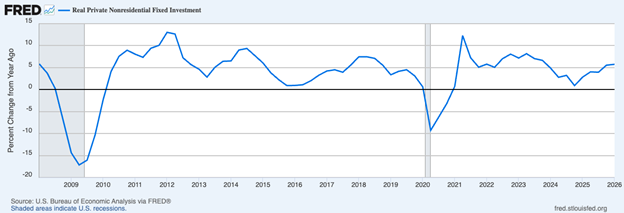
With nearly all S&P 500 companies reporting first-quarter results as I write, about 83% have beaten earnings expectations, which is the highest beat rate since 2021. Earnings strength has also broadened beyond the AI-related technology complex, with Energy, Materials, Industrials, Communication Services, and Consumer Discretionary companies contributing to better-than-expected results. In this context, negative consumer sentiment may actually be a key component of the constructive setup for markets. It’s part of the wall of worry markets love to climb.
Bottom Line for Investors
To be fair, the U.S. consumer is under pressure, especially from high prices in everyday categories. But pressure has not been resulting in retrenchment, at least not to date. Spending remains positive, higher-income households continue to support aggregate demand, and lower-income consumers appear to be adjusting rather than retreating entirely.
For markets, the key question is not whether consumers feel good. It is whether spending, earnings, and investment hold up better than today’s low expectations imply. So far, they have.
As for investors, separating headlines from what’s actually driving markets has become increasingly important. In our latest Stock Market Outlook Report5, we examine the disconnect between sentiment and market performance and what investors should be watching as expectations around growth and risk continue to evolve.
Inside, you’ll find:
- Asset allocation guidelines for today’s market environment
- Expert forecasts for inflation, rates, and economic trends
- Industry tables and rankings to help you spot opportunities
- Buy-side and sell-side consensus insights at a glance
- And much more!
If you have $500,000 or more to invest, claim your complimentary copy of the report and see how shifting market trends could influence opportunities in the months ahead.
Disclosure
2 Axios. February 26, 2026. https://www.axios.com/2026/02/26/us-economy-stock-market
3 Zacks Investment Management reserves the right to amend the terms or rescind the free-Stock Market Outlook Report offer at any time and for any reason at its discretion.
4 Fred Economic Data. May 28, 2026. https://fred.stlouisfed.org/series/PNFIC1
5 Zacks Investment Management reserves the right to amend the terms or rescind the free-Stock Market Outlook Report offer at any time and for any reason at its discretion.
DISCLOSURE
Past performance is no guarantee of future results. Inherent in any investment is the potential for loss.
Zacks Investment Management, Inc. is a wholly-owned subsidiary of Zacks Investment Research. Zacks Investment Management is an independent Registered Investment Advisory firm and acts as an investment manager for individuals and institutions. Zacks Investment Research is a provider of earnings data and other financial data to institutions and to individuals.
This material is being provided for informational purposes only and nothing herein constitutes investment, legal, accounting or tax advice, or a recommendation to buy, sell or hold a security. Do not act or rely upon the information and advice given in this publication without seeking the services of competent and professional legal, tax, or accounting counsel. Publication and distribution of this article is not intended to create, and the information contained herein does not constitute, an attorney-client relationship. No recommendation or advice is being given as to whether any investment or strategy is suitable for a particular investor. It should not be assumed that any investments in securities, companies, sectors or markets identified and described were or will be profitable. All information is current as of the date of herein and is subject to change without notice. Any views or opinions expressed may not reflect those of the firm as a whole.
Any projections, targets, or estimates in this report are forward looking statements and are based on the firm’s research, analysis, and assumptions. Due to rapidly changing market conditions and the complexity of investment decisions, supplemental information and other sources may be required to make informed investment decisions based on your individual investment objectives and suitability specifications. All expressions of opinions are subject to change without notice. Clients should seek financial advice regarding the appropriateness of investing in any security or investment strategy discussed in this presentation.
Certain economic and market information contained herein has been obtained from published sources prepared by other parties. Zacks Investment Management does not assume any responsibility for the accuracy or completeness of such information. Further, no third party has assumed responsibility for independently verifying the information contained herein and accordingly no such persons make any representations with respect to the accuracy, completeness or reasonableness of the information provided herein. Unless otherwise indicated, market analysis and conclusions are based upon opinions or assumptions that Zacks Investment Management considers to be reasonable. Any investment inherently involves a high degree of risk, beyond any specific risks discussed herein.
The S&P 500 Index is a well-known, unmanaged index of the prices of 500 large-company common stocks, mainly blue-chip stocks, selected by Standard & Poor’s. The S&P 500 Index assumes reinvestment of dividends but does not reflect advisory fees. The volatility of the benchmark may be materially different from the individual performance obtained by a specific investor. An investor cannot invest directly in an index.
The Russell 2000 Index is a well-known, unmanaged index of the prices of 2000 small-cap company common stocks, selected by Russell. The Russell 2000 Index assumes reinvestment of dividends but does not reflect advisory fees. An investor cannot invest directly in an index. The volatility of the benchmark may be materially different from the individual performance obtained by a specific investor.
The Nasdaq Composite Index measures all Nasdaq domestic and international based common type stocks listed on The Nasdaq Stock Market. To be eligible for inclusion in the Index, the security's U.S. listing must be exclusively on The Nasdaq Stock Market (unless the security was dually listed on another U.S. market prior to January 1, 2004 and has continuously maintained such listing). The security types eligible for the Index include common stocks, ordinary shares, ADRs, shares of beneficial interest or limited partnership interests and tracking stocks. Security types not included in the Index are closed-end funds, convertible debentures, exchange traded funds, preferred stocks, rights, warrants, units and other derivative securities. An investor cannot invest directly in an index.