The IPO Market Is Heating Up This Summer, But Investors Should Stay Cool
The past couple of years have been relatively a quiet stretch for new public equity offerings, but that’s set to change this summer.
Readers have almost certainly encountered commentary about SpaceX and Anthropic’s expected $1+ trillion valuations, with OpenAI in the wings preparing filings as well. In fact, SpaceX’s expected $75+ billion capital raise is poised to be the largest in history—by a long shot.
This moment in economic and U.S. corporate history is no doubt fascinating. We’ve got companies launching satellites in space, with plans to colonize Mars, and enterprises developing a transformative new technology in artificial intelligence that many believe will fundamentally change the way we do business and create economic value.1
These are interesting and exciting times, which is actually the precise reason I think investors should proceed with caution.
Why Chasing Headlines Can Hurt Your Portfolio
Artificial intelligence. Space exploration. Trillion-dollar valuations. It’s easy to see why investors are excited about the next wave of public offerings.
But excitement and investment success don’t always go hand in hand. Our latest Stock Market Outlook Report2 explores why investors should be cautious about chasing headlines, what history can teach us about periods of market enthusiasm, and why a disciplined approach remains critical when making portfolio decisions. Inside, you’ll learn:
- Asset allocation guidelines for today’s market environment
- Expert forecasts for inflation, rates, and economic trends
- Industry tables and rankings to help you spot opportunities
- Buy-side and sell-side consensus insights at a glance
- And much more!
If you have $500,000 or more to invest, claim your complimentary copy of the report and see how shifting market trends could influence opportunities in the months ahead.
IT’S FREE. Download our latest Stock Market Outlook Report2
The idea of investing early in a transformative company is one of the most attractive stories about investing. But the decision to buy can also be unduly influenced by emotion versus fundamentals. This is not to say that IPOs are universally bad investments. Some newly public companies go on to become extraordinary long-term winners. The examples I listed above could do just that.
The issue is that investors often encounter IPOs when excitement, publicity, and valuation are all peaking at the same time. SpaceX is a useful example. At an expected $1.75 trillion valuation, the stock is set to potentially start trading at nearly 100 times historical sales. That is not merely an expensive multiple, it is a multiple that assumes years of rapid growth, expanding margins, and strong execution are already on the way.
None of this is a comment on the company’s long-term potential. SpaceX may ultimately become one of the most important companies in the world, which would arguably be great for the U.S. and global economies. But investing is not just about identifying great businesses. It is about the price paid for future cash flows. A company can be exceptional and still offer a poor risk/reward tradeoff if the public-market valuation already capitalizes a decade of good news.
History supports this level of caution. University of Florida professor Jay Ritter has studied IPO performance for decades, and his data consistently show that first-day enthusiasm does not guarantee strong long-term returns. One especially relevant finding was that among sizable IPOs with more than $100 million in sales and price-to-sales ratios above 40 at the offer price, most underperformed the market over the following three years when bought at the first closing price. A price-to-sales ratio near 100 would be more than double that already elevated threshold.3
Recent IPO history tells a similar story. A Reuters analysis of the 50 highest-valued IPOs over the past five years found that investors gained an average of 27%, compared with a 53% gain for the S&P 500 over the same period, assuming access at the IPO price. Investors buying after the first-day pop generally fared worse.4 That’s one of the problems with chasing heat—by the time ordinary investors can buy, a great deal of optimism may already be reflected in the stock price. I’ll be publishing more research on this topic next week.
The broader point I want to make this week, however, is that most investors don’t need to ride the wave of one or a few companies’ transformative growth and stock performance to reach long-term goals. Why take that level of risk when we know a diversified approach to equity ownership has historically generated consistent and attractive risk-adjusted annualized returns?
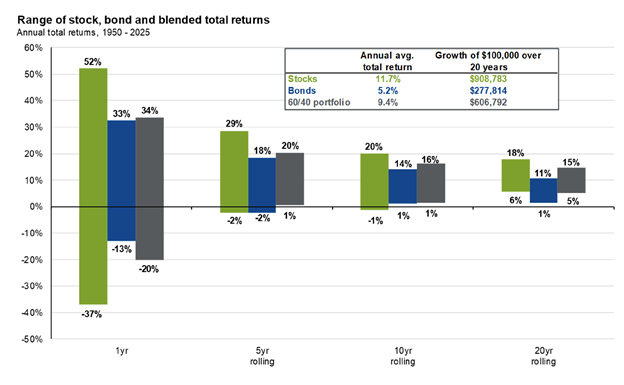
A single stock’s return profile can look like the 1-year range of outcomes in the chart below. As seen by the green bar representing the S&P 500 over the past 75 years, the range of potential outcomes went as high as +52% in a single year to as low as -37%. Diversifying to a 60/40 portfolio narrows that range of outcomes substantially, such that there was not a single 5-year period in that time with a negative return. If you zoom out to 20-year periods, the lowest annual total return for the S&P 500 was +6%. Diversification and time can generate solid returns with controlled volatility.
My overarching point is that investors do not need to identify the next great IPO to build wealth. You do not need perfect timing, special access, or a concentrated bet on the company dominating the headlines. For many investors, the path to meeting long-term goals is more likely to come from disciplined, long-term participation in broad markets—not an IPO.
Bottom Line for Investors
None of what I’ve written above is meant to discourage investors from studying new public companies and potentially investing. IPOs can introduce innovative businesses to the market, and some will become important companies in the years and perhaps decades ahead.
But the decision to invest should be based on fundamentals, valuation, risk, and fit within a portfolio, not a fear of missing out. In next week’s column, I will elaborate more on this point by digging deeper into the performance of IPOs in the very short term versus many years out.
At the end of the day, a diversified, long-term portfolio may not generate the same excitement as a headline IPO, but history suggests it offers something much more valuable, in my view: a disciplined path for building wealth over time.
Separating headlines from investment fundamentals has become increasingly important. In our latest Stock Market Outlook Report6, we examine how market narratives can influence investor behavior, why valuation still matters, and what investors should be watching as expectations around growth and risk continue to evolve.
Inside, you’ll find:
- Asset allocation guidelines for today’s market environment
- Expert forecasts for inflation, rates, and economic trends
- Industry tables and rankings to help you spot opportunities
- Buy-side and sell-side consensus insights at a glance
- And much more!
If you have $500,000 or more to invest, claim your complimentary copy of the report and see how shifting market trends could influence opportunities in the months ahead.
Disclosure
Zacks Investment Management, Inc. is a wholly-owned subsidiary of Zacks Investment Research. Zacks Investment Management is an independent Registered Investment Advisory firm and acts an investment manager for individuals and institutions. Zacks Investment Research is a provider of earnings data and other financial data to institutions and to individuals.
This material is being provided for informational purposes only and nothing herein constitutes investment, legal, accounting or tax advice, or a recommendation to buy, sell or hold a security. Do not act or rely upon the information and advice given in this publication without seeking the services of competent and professional legal, tax, or accounting counsel. The information contained herein has been obtained from sources believed to be reliable but we do not guarantee accuracy or completeness. Publication and distribution of this article is not intended to create, and the information contained herein does not constitute, an attorney-client relationship. No recommendation or advice is being given as to whether any investment or strategy is suitable for a particular investor. It should not be assumed that any investments in securities, companies, sectors or markets identified and described were or will be profitable. All information is current as of the date of herein and is subject to change without notice. Any views or opinions expressed may not reflect those of the firm as a whole.