From energy shocks to shifting Fed expectations, markets are adjusting quickly. In this issue of Steady Investor, we break down the key trends investors are watching right now, including:
- Markets weigh inflation risks
- The $110 trillion wealth shift
- Global economy holds up
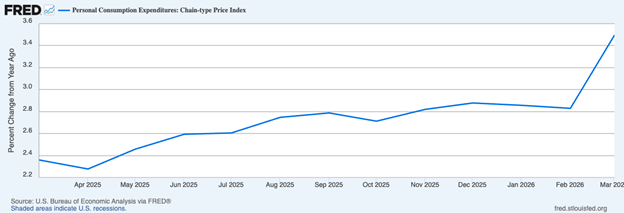
More Mixed Signals from the U.S. Economy, But Growth Remains the Story – The latest batch of economic data out this week paints a fairly mixed picture for the U.S. economy. Inflation picked up sharply, driven of course by higher energy prices. Consumer spending softened as U.S. households adjust their spending. And the health of the jobs market is all about where you look. Some sectors, like healthcare, are seeing hiring booms, while others, like Technology, are experiencing material layoffs. On balance, however, layoffs fell to the lowest level in more than five decades, signaling that strength and weakness are happening in pockets.Let’s start with the latest data on inflation. The Fed’s preferred inflation gauge, the personal consumption expenditures price index, rose 0.7% in March, pushing the annual rate to 3.5% (chart below). Core PCE, which excludes food and energy, rose 0.3% for the month and 3.2% year-over-year, its highest annual reading since November 2023. Much of the pressure came from energy, where prices surged as the Iran war pushed oil prices higher and gasoline climbed above $4 per gallon.1
The Fed’s Preferred Inflation Gauge, the PCE Price Index
Markets Are Changing. Is Your Strategy Keeping Up?
Markets are adjusting to a new environment shaped by shifting Fed expectations, persistent inflation concerns, and changing market leadership. In periods like this, reacting emotionally to headlines can become costly.
Navigating Market Volatility3 is a free guide designed to help you stay disciplined when markets feel uncertain. It outlines four practical principles to help you cut through the noise, manage risk, and stay confident in your long-term plan. Download it to learn how to:
- Sharp market declines and corrections are a normal part of investing
- The best market days come unexpectedly (often within days or weeks of the worst days)
- Trying to pick market tops and bottoms is nearly impossible
- Trust your strategy and discipline, not the headlines
- Plus, more insights and assistance to help you keep your investment strategy on course
If you have $500,000 or more to invest, get your free volatility guide today!
Download Your Free Copy Today: Navigating Market Volatility: 4 Principles for Staying the Course3
With inflation still running above target and energy prices creating a fresh source of pressure, policymakers appear to have little urgency to restart rate cuts. The labor market also somewhat complicates the rate picture, as initial jobless claims fell to 189,000 for the week ended April 25, down 26,000 from the prior week and well below expectations. That was the lowest reading since September 1969. The labor market has been in a low-hire, low-fire pattern for much of the past year, but the latest claims data suggest employers are still reluctant to cut workers. Overall, with Q1 GDP coming in at 2% and the services sector showing strong expansion, the data still point to an economy absorbing pressures rather than buckling under them.
Delayed: A $110 Trillion “Wealth Transfer” – For years, the financial media have talked about the “great wealth transfer” as if it were a single, looming event. As told, baby boomers would be passing down trillions of dollars to their children and grandchildren in a flood of new generational wealth. The reality is likely to be slower, more uneven, and more complex.
Older Americans are sitting on an estimated $110 trillion of wealth, much of it held by baby boomers and Gen X. Over the past few decades, that wealth has grown sharply, helped by rising stock prices, business ownership, and decades of home price appreciation. One analysis using Federal Reserve data found that bequeathable wealth, net worth excluding pensions and annuities that typically cannot be passed down, rose from 256% of GDP in 1997 to 424% in 2021. But that does not mean younger generations should expect a sudden windfall. Much of the wealth is still held by households that could have decades of life ahead of them. In 2021, the age group with the most aggregate wealth was 55 to 64 years old, according to research from Brookings. Wealthier Americans also tend to live longer, with the top 1% of earners living, on average, into their late 80s. That alone stretches out the timeline. In Federal Reserve surveys conducted between 1998 and 2010, Americans in their late 50s were the most likely to report receiving an inheritance. In surveys conducted between 2013 and 2022, the peak inheritance age had shifted to the mid-60s. The wealth transfer is happening, but not necessarily at the age or speed many younger households might expect.4
Despite Many Crosscurrents of Pressure, the Global Economy Holds Up – The global economy is facing its most serious energy shock in decades, but so far, growth outside the U.S. has held up better than many feared.The closure of the Strait of Hormuz has removed roughly 13 million barrels of oil per day from global energy supplies and pushed Brent crude prices more than 50% higher. Some countries are already feeling the strain, with blackouts, fuel rationing, and shorter workweeks appearing in parts of Asia and emerging markets. Even so, major economies have not yet seen the type of swift downturns that accompanied energy shocks in the 1970s or early 1990s.One reason is that the world has become more energy efficient. Since 2000, the amount of energy needed to generate a dollar of inflation-adjusted GDP has fallen by about one-third in the U.S. and Europe and roughly 40% in China. Energy reserves have also helped cushion the blow, with Japan, Korea, Europe, and China all entering the crisis with sizable stockpiles.Interestingly enough, the AI boom is providing another offset. Demand for chips, electronics, and machinery has supported Asian exporters, with March exports up 12% year-over-year in Japan, nearly 50% in South Korea, and 68% in Taiwan. Hong Kong also surprised to the upside, with first-quarter GDP rising 5.9% from a year earlier, helped by exports, financial market strength, and improving sentiment.The risks are still meaningful, especially if the strait remains closed into next year. But for now, the global economy is absorbing the shock far better than expected, in our view.5
How Should Investors Respond to Today’s Market Uncertainty? – Even with markets facing new inflation concerns and global uncertainty, the economy has continued to show more resilience than many expected.
Our exclusive guide, Navigating Market Volatility6 is a free guide that offers a clear framework for staying disciplined and managing risk during uncertain markets. It covers topics such as:
- Sharp market declines and corrections are a normal part of investing
- The best market days come unexpectedly (often within days or weeks of the worst days)
- Trying to pick market tops and bottoms is nearly impossible
- Trust your strategy and discipline, not the headlines
- Plus, more insights and assistance to help you keep your investment strategy on course
If you have $500,000 or more to invest, access your free volatility guide today.
Disclosure
2 Fred Economic Data. 2026.
3 Zacks Investment Management reserves the right to amend the terms or rescind the free Navigating Market Volatility: 4 Principles for Staying the Course offer at any time and for any reason at its discretion.
4 Wall Street Journal. May 4, 2026. https://www.wsj.com/articles/the-great-110-trillion-wealth-transfer-wont-happen-any-time-soon-e8b2ef31
5 Wall Street Journal. May 3, 2026. https://www.wsj.com/economy/global/global-economy-iran-energy-abd8828f?mod=economy_lead_pos4
6 Zacks Investment Management reserves the right to amend the terms or rescind the free Navigating Market Volatility: 4 Principles for Staying the Course offer at any time and for any reason at its discretion.
DISCLOSURE
Past performance is no guarantee of future results. Inherent in any investment is the potential for loss.
Zacks Investment Management, Inc. is a wholly-owned subsidiary of Zacks Investment Research. Zacks Investment Management is an independent Registered Investment Advisory firm and acts as an investment manager for individuals and institutions. Zacks Investment Research is a provider of earnings data and other financial data to institutions and to individuals.
This material is being provided for informational purposes only and nothing herein constitutes investment, legal, accounting or tax advice, or a recommendation to buy, sell or hold a security. Do not act or rely upon the information and advice given in this publication without seeking the services of competent and professional legal, tax, or accounting counsel. Publication and distribution of this article is not intended to create, and the information contained herein does not constitute, an attorney-client relationship. No recommendation or advice is being given as to whether any investment or strategy is suitable for a particular investor. It should not be assumed that any investments in securities, companies, sectors or markets identified and described were or will be profitable. All information is current as of the date of herein and is subject to change without notice. Any views or opinions expressed may not reflect those of the firm as a whole.
Any projections, targets, or estimates in this report are forward looking statements and are based on the firm’s research, analysis, and assumptions. Due to rapidly changing market conditions and the complexity of investment decisions, supplemental information and other sources may be required to make informed investment decisions based on your individual investment objectives and suitability specifications. All expressions of opinions are subject to change without notice. Clients should seek financial advice regarding the appropriateness of investing in any security or investment strategy discussed in this presentation.
Certain economic and market information contained herein has been obtained from published sources prepared by other parties. Zacks Investment Management does not assume any responsibility for the accuracy or completeness of such information. Further, no third party has assumed responsibility for independently verifying the information contained herein and accordingly no such persons make any representations with respect to the accuracy, completeness or reasonableness of the information provided herein. Unless otherwise indicated, market analysis and conclusions are based upon opinions or assumptions that Zacks Investment Management considers to be reasonable. Any investment inherently involves a high degree of risk, beyond any specific risks discussed herein.
It is not possible to invest directly in an index. Investors pursuing a strategy similar to an index may experience higher or lower returns, which will be reduced by fees and expenses.
The S&P 500 Index is a well-known, unmanaged index of the prices of 500 large-company common stocks, mainly blue-chip stocks, selected by Standard & Poor’s. The S&P 500 Index assumes reinvestment of dividends but does not reflect advisory fees. The volatility of the benchmark may be materially different from the individual performance obtained by a specific investor. An investor cannot invest directly in an index.
The Russell 1000 Growth Index is a well-known, unmanaged index of the prices of 1000 large-company growth common stocks selected by Russell. The Russell 1000 Growth Index assumes reinvestment of dividends but does not reflect advisory fees. An investor cannot invest directly in an index. The volatility of the benchmark may be materially different from the individual performance obtained by a specific investor.
Nasdaq Composite Index is the market capitalization-weighted index of over 3,300 common equities listed on the Nasdaq stock exchange. The types of securities in the index include American depositary receipts, common stocks, real estate investment trusts (REITs) and tracking stocks, as well as limited partnership interests. The index includes all Nasdaq-listed stocks that are not derivatives, preferred shares, funds, exchange-traded funds (ETFs) or debenture securities. An investor cannot invest directly in an index. The volatility of the benchmark may be materially different from the individual performance obtained by a specific investor.
“The Dow Jones Industrial Average measures the daily stock market movements of 30 U.S. publicly-traded companies listed on the NASDAQ or the New York Stock Exchange (NYSE). The 30 publicly-owned companies are considered leaders in the United States economy. An investor cannot directly invest in an index. The volatility of the benchmark may be materially different from the individual performance obtained by a specific investor.”
Returns for each strategy and the corresponding Morningstar Universe reflect the annualized returns for the periods indicated. The Morningstar Universes used for comparative analysis are constructed by Morningstar (median performance) and data is provided to Zacks by Zephyr Style Advisor. The percentile ranking for each Zacks Strategy is based on the gross comparison for Zacks Strategies vs. the indicated universe rounded up to the nearest whole percentile. Other managers included in universe by Morningstar may exhibit style drift when compared to Zacks Investment Management portfolio. Neither Zacks Investment Management nor Zacks Investment Research has any affiliation with Morningstar. Neither Zacks Investment Management nor Zacks Investment Research had any influence of the process Morningstar used to determine this ranking.