In this week’s edition of Steady Investor, we break down the latest developments shaping the economic and market outlook, including:
- Trade tensions rise, risks contained
- Rising yields pressure global bonds
- Fed policy uncertainty takes focus
Will the Escalating U.S.-Canada Trade Spat Hurt Markets? The U.S.-Canada trade dispute escalated again after trade talks broke down and the U.S. imposed 50% tariffs on a targeted group of Canadian goods. Canada responded with plans for dollar-for-dollar retaliation, which prompted the U.S. to threaten to raise tariffs on Canadian autos and auto parts to 50% starting January 1, 2027.As a general economic principle, we are no fans of tariffs and trade wars. Tariffs are almost always a negative because they raise costs for businesses and consumers, and in our view, it ultimately hurts the imposer as much as the target. In the context of this current escalation, however, investors should weigh the scale and timing. The new U.S. tariffs apply to about $20 billion to $28 billion of Canadian goods, depending on the estimate, which represents a very small share of total U.S.-Canada trade. Recent reporting pegs the affected goods at roughly 5% of Canadian exports to the U.S., while most trade between the two countries remains governed by USMCA rules. Canada’s retaliatory tariffs are also scheduled to start September 8, leaving room for further negotiations in the coming weeks.We are not implying that the impact here is so negligible that it should be outright ignored. But remember, markets have had a lot of experience with tariff volatility over the past year, and unless the dispute broadens meaningfully, this still looks more like another trade-policy flare-up than a major threat to the expansion.1
What Today’s Market Signals Mean for Investors
Geopolitical uncertainty has returned to center stage, fueling market volatility and raising new questions for investors. While headlines can drive short-term reactions, history suggests markets often prove more resilient over the long run.
Our exclusive guide, How Geopolitical Crises Affect the Stock Market 2, shows how major events influence markets and provides perspective for your next moves.
Inside, you’ll find:
- Five significant conflicts since World War II, from Korea to Crimea
- An analysis of each conflict and its economic impacts
- U.S. GDP and S&P 500 figures for key periods of these wars
- Plus, more insights on how these crises affect the economy and market
If you have $500,000 or more to invest, request this report today!
Download Your Free Guide, How Geopolitical Crises Affect the Stock Market 2
Bond Woes Go Global – The recent rise in U.S. Treasury yields has drawn plenty of attention, and it’s the subject of Mitch Zacks’ latest Mitch on the Markets column. But the upward pressure on yields is not limited to the U.S.Global debt has surpassed $350 trillion, according to the Institute of International Finance, equal to about 305% of global GDP. Governments in advanced economies alone are expected to borrow roughly $18 trillion this year, according to the OECD. That growing supply of debt is arriving at a time when investors are also weighing inflation risk, central-bank uncertainty, and competition from other asset classes.The pressure has been especially visible overseas. France’s 10-year yield has risen about half a percentage point since the end of June, while Italy’s has climbed nearly as much. By comparison, the U.S. 10-year Treasury yield is up about 0.2 percentage point over the same stretch. Japan’s bond market has also been under pressure as inflation becomes more entrenched after decades of deflation, while U.K. yields remain sensitive to fiscal concerns and shifting demand from traditional buyers like pension funds.3
Yields on Developed Market Debt Have Been Rising in 2026 (UK, Japan, France, and U.S. pictured)
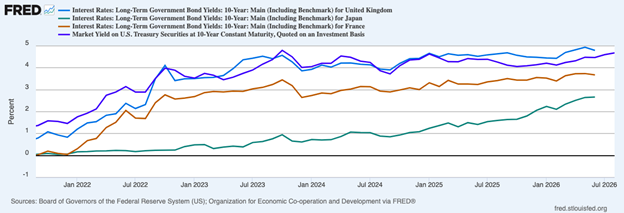
The common thread is that higher debt levels make markets more sensitive to changes in inflation expectations, politics, and central-bank credibility. When investors demand more compensation to lend, borrowing costs rise for governments—which can translate to higher borrowing costs for businesses and households.
What Investors Should Watch for as the Fed Heads to Jackson Hole – Fed Chair Kevin Warsh heads to Jackson Hole with a basic question still unanswered: is inflation being kept above target by temporary shocks, or by an economy running too hot? If tariffs, the Iran war, and higher energy costs are the main drivers of above-target inflation, the Fed may be able to wait for those pressures to fade. But if strong demand, AI-driven investment, and healthy credit growth are allowing price increases to stick, then the argument for higher rates becomes stronger. The Fed is clearly divided. Three officials voted to raise rates at the July meeting, the most dissents in a decade, while others remain more patient. Softer inflation data over the past two months has reduced pressure for an immediate move in September, but inflation has still been above the Fed’s 2% target for more than five years. That puts Warsh’s leadership style—and his press conference in Jackson Hole—in focus. Warsh has argued the Fed should communicate less and avoid giving markets too much forward guidance, but the flip side to this approach is that markets are increasingly in the dark. Markets do not need a guaranteed rate path, but they do need to understand what data the Fed is watching and how policy might respond. That’s what makes Warsh’s speech so meaningful—it can give markets a clearer framework for interpreting the Fed’s next move.5
Navigating Markets During Geopolitical Uncertainty – Ongoing geopolitical and economic uncertainty continues to shape investor sentiment and contribute to periods of market volatility.
Understanding the potential impact of these developments may help investors make more informed decisions and maintain a long-term perspective.
Download our exclusive guide, How Geopolitical Crises Affect the Stock Market6, to explore how stocks have historically responded to major global events and what past periods of disruption can teach investors today.
Inside, you’ll discover:
- Five significant conflicts since World War II, from Korea to Crimea
- An analysis of each conflict and its economic impacts
- U.S. GDP and S&P 500 figures for key periods of these wars
- Plus, more insights on how these crises affect the economy and market
If you have $500,000 or more to invest, request this report today!
Disclosure
2 Zacks Investment Management reserves the right to amend the terms or rescind the free How Geopolitical Crises Affect the Stock Market offer at any time and for any reason at its discretion.
3 Wall Street Journal. August 27, 2026. https://www.wsj.com/economy/global/think-treasurys-are-having-a-rough-summer-its-even-uglier-abroad-7224cf70?mod=finance_lead_pos5
4 Fred Economic Data. July 16, 2026. https://www.wsj.com/economy/global/think-treasurys-are-having-a-rough-summer-its-even-uglier-abroad-7224cf70?mod=finance_lead_pos5
5 Wall Street Journal. August 26, 2026. https://www.wsj.com/economy/global/think-treasurys-are-having-a-rough-summer-its-even-uglier-abroad-7224cf70?mod=finance_lead_pos5
6 Zacks Investment Management reserves the right to amend the terms or rescind the free How Geopolitical Crises Affect the Stock Market offer at any time and for any reason at its discretion.
DISCLOSURE
Past performance is no guarantee of future results. Inherent in any investment is the potential for loss.
Zacks Investment Management, Inc. is a wholly-owned subsidiary of Zacks Investment Research. Zacks Investment Management is an independent Registered Investment Advisory firm and acts as an investment manager for individuals and institutions. Zacks Investment Research is a provider of earnings data and other financial data to institutions and to individuals.
This material is being provided for informational purposes only and nothing herein constitutes investment, legal, accounting or tax advice, or a recommendation to buy, sell or hold a security. Do not act or rely upon the information and advice given in this publication without seeking the services of competent and professional legal, tax, or accounting counsel. Publication and distribution of this article is not intended to create, and the information contained herein does not constitute, an attorney-client relationship. No recommendation or advice is being given as to whether any investment or strategy is suitable for a particular investor. It should not be assumed that any investments in securities, companies, sectors or markets identified and described were or will be profitable. All information is current as of the date of herein and is subject to change without notice. Any views or opinions expressed may not reflect those of the firm as a whole.
Any projections, targets, or estimates in this report are forward looking statements and are based on the firm’s research, analysis, and assumptions. Due to rapidly changing market conditions and the complexity of investment decisions, supplemental information and other sources may be required to make informed investment decisions based on your individual investment objectives and suitability specifications. All expressions of opinions are subject to change without notice. Clients should seek financial advice regarding the appropriateness of investing in any security or investment strategy discussed in this presentation.
Certain economic and market information contained herein has been obtained from published sources prepared by other parties. Zacks Investment Management does not assume any responsibility for the accuracy or completeness of such information. Further, no third party has assumed responsibility for independently verifying the information contained herein and accordingly no such persons make any representations with respect to the accuracy, completeness or reasonableness of the information provided herein. Unless otherwise indicated, market analysis and conclusions are based upon opinions or assumptions that Zacks Investment Management considers to be reasonable. Any investment inherently involves a high degree of risk, beyond any specific risks discussed herein.
It is not possible to invest directly in an index. Investors pursuing a strategy similar to an index may experience higher or lower returns, which will be reduced by fees and expenses.
The S&P 500 Index is a well-known, unmanaged index of the prices of 500 large-company common stocks, mainly blue-chip stocks, selected by Standard & Poor’s. The S&P 500 Index assumes reinvestment of dividends but does not reflect advisory fees. The volatility of the benchmark may be materially different from the individual performance obtained by a specific investor. An investor cannot invest directly in an index.
The Russell 1000 Growth Index is a well-known, unmanaged index of the prices of 1000 large-company growth common stocks selected by Russell. The Russell 1000 Growth Index assumes reinvestment of dividends but does not reflect advisory fees. An investor cannot invest directly in an index. The volatility of the benchmark may be materially different from the individual performance obtained by a specific investor.
Nasdaq Composite Index is the market capitalization-weighted index of over 3,300 common equities listed on the Nasdaq stock exchange. The types of securities in the index include American depositary receipts, common stocks, real estate investment trusts (REITs) and tracking stocks, as well as limited partnership interests. The index includes all Nasdaq-listed stocks that are not derivatives, preferred shares, funds, exchange-traded funds (ETFs) or debenture securities. An investor cannot invest directly in an index. The volatility of the benchmark may be materially different from the individual performance obtained by a specific investor.
“The Dow Jones Industrial Average measures the daily stock market movements of 30 U.S. publicly-traded companies listed on the NASDAQ or the New York Stock Exchange (NYSE). The 30 publicly-owned companies are considered leaders in the United States economy. An investor cannot directly invest in an index. The volatility of the benchmark may be materially different from the individual performance obtained by a specific investor.”
Returns for each strategy and the corresponding Morningstar Universe reflect the annualized returns for the periods indicated. The Morningstar Universes used for comparative analysis are constructed by Morningstar (median performance) and data is provided to Zacks by Zephyr Style Advisor. The percentile ranking for each Zacks Strategy is based on the gross comparison for Zacks Strategies vs. the indicated universe rounded up to the nearest whole percentile. Other managers included in universe by Morningstar may exhibit style drift when compared to Zacks Investment Management portfolio. Neither Zacks Investment Management nor Zacks Investment Research has any affiliation with Morningstar. Neither Zacks Investment Management nor Zacks Investment Research had any influence of the process Morningstar used to determine this ranking.
The Russell 1000 Value Index is a well-known, unmanaged index of the prices of 1000 large-company value common stocks selected by Russell. The Russell 1000 Value Index assumes reinvestment of dividends but does not reflect advisory fees. An investor cannot directly invest in an index. The volatility of the benchmark may be materially different from the individual performance obtained by a specific investor.