Steady Investor Weekly
Keeping up with market headlines is one thing. Understanding what they could mean for your portfolio is another. In this week’s Steady Investor, we take a closer look at the trends influencing markets and the bigger picture for investors, including:
- Consumer spending rises despite pessimism
- France fuels global bond concerns
- Tech leads stocks to highs
Consumers Keep Spending Despite the Gloom – Americans are not feeling especially upbeat about the economy, according to the University of Michigan’s Consumer Sentiment Index1:
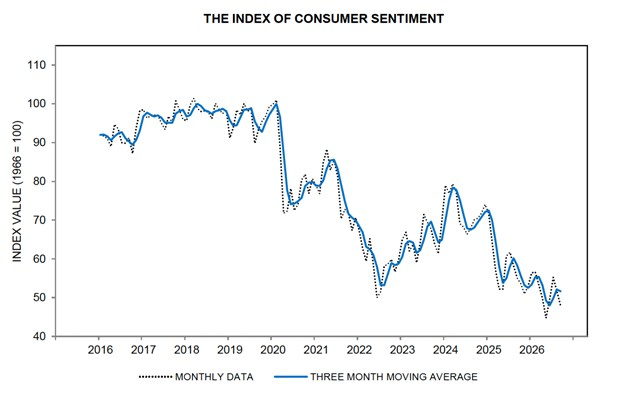
But Americans are still spending. Household spending rose 6.1% in the 12 months through August, up from 4.3% growth at the end of last year. Inflation accounts for part of that increase, but not all of it. Real, inflation-adjusted consumer spending still rose 2.6% from a year earlier and jumped 0.6% in August alone, its strongest monthly gain since March 2025. Spending is up across income groups, too. A New York Fed survey found spending rose 4.7% over the past year among households earning less than $50,000 and 4.4% among those earning more than $100,000. When readers look at the chart above, however, and hear stories about Americans souring on the economy, the contrast between sentiment and spending can seem striking. To be sure, there have been some trade-offs made to get here. The personal saving rate has fallen to 4.1% of after-tax income, and household debt has continued to rise, suggesting some consumers have less cushion than before. Even still, for investors it’s important to focus on what households do (spending data), not what they say (sentiment data).2
Keep Your Retirement Goals in Focus as Markets Change
Market swings and shifting economic conditions can make it easy to focus on your retirement balance. But the life you want to live deserves attention, too. Use this time to revisit when you want to retire, where you want to live, and how you want to spend your days.
Our free guide, 6 Secrets for Happy Retirement³, can help you turn those goals into a clearer plan, including:
- Aligning your retirement vision with your partner’s
- Choosing a retirement timeline that fits your needs
- Exploring where you want to live and what to consider before moving
- Making room for the activities and interests you look forward to
- And more…
Explore our guide and start building a retirement plan around both your financial needs and the life you want to enjoy.
Get our FREE guide: 6 Secrets for Happy Retirement3
France Adds Another Flashpoint to the Global Bond Selloff – Rising government bond yields have become a global story, and readers have probably seen headlines this week about France’s deteriorating fiscal situation. French borrowing costs have climbed as investors wrestle with a large fiscal deficit, rising debt-service costs, and political uncertainty ahead of next year’s presidential election. France’s national debt stood near €2.9 trillion in August, while its budget deficit is expected to equal roughly 5.4% of GDP this year. One government estimate suggests annual debt-service costs could reach €124 billion by 2030.Those concerns have pushed the spread between French and German 10-year bond yields—a widely watched gauge of relative credit risk—to its widest level since the eurozone debt crisis in 2012. For readers who remember the ‘Greek sovereign debt crisis,’ France’s current position echoes that setup. What is perhaps more concerning, however, is that France is not alone. Government yields have also risen in the U.S., Germany, Japan, and the U.K., reflecting a broader mix of inflation concerns, elevated borrowing needs, and changing expectations for interest rates.4
10-Year Government Bond Yields of France, Germany, UK, Japan, and U.S.
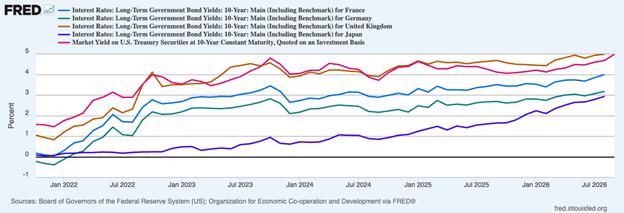
For investors, we’d urge watching to see if weakness begins spreading more materially across European credit markets. At the same time, higher French yields do not by themselves signal an approaching contagion event. France continues to service its obligations, and its interest burden remains manageable today. The more useful takeaway, in our view, is that increasingly indebted governments worldwide are competing for capital in a higher-rate environment, which is what makes sovereign bond markets an important source of risk to watch going forward.
U.S. Stocks Hit New Highs, But “Breadth” Remains a Concern – U.S. stocks have continued reaching new highs, even with 10-year Treasury yields above 5% and oil near $100 a barrel. But we’re back to a familiar story about what’s driving stocks higher: Technology. The combined market value of the Magnificent Seven recently reached roughly $25 trillion, while fewer than half of S&P 500 companies were trading above their 200-day moving averages. That narrowing breadth has fueled concerns that the rally depends too heavily on a small group of companies, which is similar to the concern we’ve seen in previous years. Context is important here, in our view. The broader market is hardly standing still, as the equal-weighted S&P 500 was up over 12% year to date (as we write), compared with ~15% for the traditional market-cap-weighted index. That is underperformance, but it is not evidence that everything outside mega-cap technology is falling apart.6
Take the Next Step Toward the Retirement You Want – As you follow the markets, keep your bigger retirement goals in view. When will you retire? Where will you live? What do you want to spend more time doing?
Our free guide, 6 Secrets for Happy Retirement3, helps you explore these decisions, from choosing your retirement timing and location to making time for the activities and interests you enjoy.
Use it to clarify your priorities and start planning for a retirement that reflects them. Get your FREE 6 Secrets for Happy Retirement3 and take the next step today.
Disclosure
2 Wall Street Journal. October 4, 2026. “The Mighty American Consumer Is Crashing Through Inflation and Driving Growth.”
3 Zacks Investment Management reserves the right to amend the terms or rescind the free 6 Secrets for Happy Retirement offer at any time and for any reason at its discretion.
4 Wall Street Journal. October 8, 2026. “Default May Be the Tail Risk Haunting French Bonds.”
5 FRED, Fred Economic Data. September 15, 2026. “Interest Rates: Long-Term Government Bond Yields: 10-Year: Main (Including Benchmark) for France.”
6 Wall Street Journal. October 6, 2026. “The S&P 500 Hits a New Record High, Powered by Tech—and Not Much Else.”
DISCLOSURE
Past performance is no guarantee of future results. Inherent in any investment is the potential for loss.
Zacks Investment Management, Inc. is a wholly-owned subsidiary of Zacks Investment Research. Zacks Investment Management is an independent Registered Investment Advisory firm and acts as an investment manager for individuals and institutions. Zacks Investment Research is a provider of earnings data and other financial data to institutions and to individuals.
This material is being provided for informational purposes only and nothing herein constitutes investment, legal, accounting or tax advice, or a recommendation to buy, sell or hold a security. Do not act or rely upon the information and advice given in this publication without seeking the services of competent and professional legal, tax, or accounting counsel. Publication and distribution of this article is not intended to create, and the information contained herein does not constitute, an attorney-client relationship. No recommendation or advice is being given as to whether any investment or strategy is suitable for a particular investor. It should not be assumed that any investments in securities, companies, sectors or markets identified and described were or will be profitable. All information is current as of the date of herein and is subject to change without notice. Any views or opinions expressed may not reflect those of the firm as a whole.
Any projections, targets, or estimates in this report are forward looking statements and are based on the firm’s research, analysis, and assumptions. Due to rapidly changing market conditions and the complexity of investment decisions, supplemental information and other sources may be required to make informed investment decisions based on your individual investment objectives and suitability specifications. All expressions of opinions are subject to change without notice. Clients should seek financial advice regarding the appropriateness of investing in any security or investment strategy discussed in this presentation.
Certain economic and market information contained herein has been obtained from published sources prepared by other parties. Zacks Investment Management does not assume any responsibility for the accuracy or completeness of such information. Further, no third party has assumed responsibility for independently verifying the information contained herein and accordingly no such persons make any representations with respect to the accuracy, completeness or reasonableness of the information provided herein. Unless otherwise indicated, market analysis and conclusions are based upon opinions or assumptions that Zacks Investment Management considers to be reasonable.
Any investment inherently involves a high degree of risk, beyond any specific risks discussed herein.
It is not possible to invest directly in an index. Investors pursuing a strategy similar to an index may experience higher or lower returns, which will be reduced by fees and expenses.
The S&P 500 Index is a well-known, unmanaged index of the prices of 500 large-company common stocks, mainly blue-chip stocks, selected by Standard & Poor’s. The S&P 500 Index assumes reinvestment of dividends but does not reflect advisory fees. The volatility of the benchmark may be materially different from the individual performance obtained by a specific investor. An investor cannot invest directly in an index.