In today’s Steady Investor, we look at the latest economic signals and what they could mean for markets and investors, including:
- Inflation eases, Fed stays cautious
- Tariff refunds boost corporate earnings
- Credit delinquencies send mixed signals
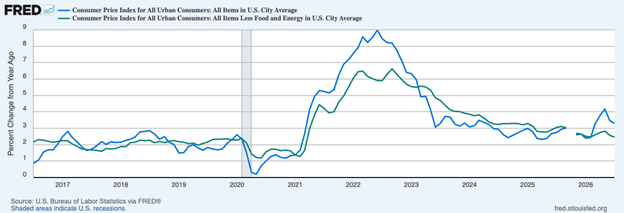
Inflation Eased in July But Remains Well Above the Fed’s Target – July’s inflation data offered some relief, but probably not enough to nudge the Federal Reserve back into rate cutting mode. According to the U.S. Bureau of Labor Statistics, consumer prices rose 3.4% from a year earlier, down slightly from 3.5% in June. Core inflation, which excludes food and energy, eased to 2.5% from 2.6%, its lowest annual reading since 2021. On a monthly basis, headline CPI rose 0.2%, while core prices also increased 0.2%.1
Headline (Blue Line) and Core (Green Line) Consumer Price Index Over the Past 10 Years
Is Your Retirement Plan Built for Changing Conditions?
Inflation, interest rates, and shifting economic conditions can all create uncertainty for retirees. But a sound retirement strategy should be built with the long term in mind.
Download our free guide, 8 Steps Toward a Stress-Free Retirement3, to learn how to build a plan focused on long-term stability and income, including:
- How to plan for emergencies that can derail your retirement investments
- Why missing just 25 trading days can decimate your returns
- Three ways to generate income during retirement
- Plus, other key steps to help you realize your retirement goals
If you have $500,000 or more to invest and would like to learn more about retirement planning considerations, download 8 Steps Toward a Stress-Free Retirement3.
Many market participants tend to focus on CPI when measuring inflation, but we also think it’s smart to monitor producer prices, which tend to feed down to consumer prices. On that front, the producer-price index was unchanged in July, better than economists’ expectations for a 0.2% increase, after falling 0.1% in June. Wholesale energy prices edged lower, helping keep input-cost pressure contained.The next inflation report to watch for will be the Fed’s preferred PCE report, due later this month, which may provide confirmation on whether inflation is truly easing.Regardless of whatever move we may see, inflation remains above the 2% target, and several officials have argued rates may still be too low. That makes the odds of a rate cut at the September meeting quite low, in our view.
How Tariff Refunds are Impacting U.S. Corporate Earnings – Tariff refunds are starting to flow back to U.S. companies, creating a short-term boost to earnings for some firms (note: the mention of individual companies is not a recommendation to buy or sell any security). So far, more than 40 S&P 500 companies have reported about $9.6 billion in refunds, with at least $2.1 billion already received in cash. Some of the largest reported amounts include roughly $2.2 billion for Apple, $986 million for Nike, $800 million for FedEx, $640 million for Amazon, and $500 million for General Motors. U.S. Customs and Border Protection had received more than 252,000 refund applications as of July 31 and accepted $128.7 billion in refunds for processing.
For some companies, the impact has been meaningful. Apple said tariff refunds added 11 cents to quarterly earnings per share, about 5% of the quarter’s total. GE HealthCare said refunds contributed 18 cents of its $1.24 in quarterly EPS. It’s not all a flow-through to earnings, however. Refunds are being booked differently across companies, and some firms are still waiting for cash. Others are passing refunds back to customers. More importantly, many companies continue to face ongoing tariff costs. Caterpillar, for example, recorded $392 million in expected recoveries but still expects $2.2 billion in tariff payments this year. The takeaway is that refunds can help near-term earnings, but they are not the same as recurring profit growth. It’s important not to conflate the two.4
Credit Card Delinquencies are Sending Mixed Signals About Consumers – Credit-card delinquencies have been getting attention recently, as one widely followed measure has risen to its highest level since the aftermath of the 2008 financial crisis. But a closer look suggests the headline may be overstating the degree of new consumer stress.The issue comes down to how long severely delinquent debts remain in the data. The New York Fed’s measure includes credit-card loans that are 90 or more days past due, including balances that lenders have already charged off as unlikely to be collected. Those balances can remain on credit reports long after the loan has left a bank’s books.That reporting pattern appears to have changed. Between 2004 and 2012, about 40% of charged-off debts were still being reported one year later. By 2024, that share had doubled. As a result, the stock of reported delinquent debt has kept rising even though the flow of new delinquencies has stabilized.When researchers exclude severely derogatory balances, credit-card delinquencies have been steadier since 2024. The broader consumer-credit picture also looks more stable: total household debt fell by $13 billion in the second quarter, while delinquency rates across consumer loans were generally steady.5
Retire with Confidence in This Market – Market downturns, inflation, and unexpected expenses can put even a well-planned retirement at risk. And once you’re relying on your portfolio for income, recovering from setbacks can become more difficult.
Our complimentary report, 8 Steps Toward a Stress-Free Retirement6, explores practical strategies to help you prepare, including:
- The “magic number” every retirement investor needs to know
- How to plan for emergencies that can derail your retirement investments
- Why missing just 25 trading days can decimate your returns
- Three ways to generate income during retirement
- Plus, other key steps to help you realize your retirement goals
If you have $500,000 or more to invest, click on the link below to get your free copy today!
Disclosure
2 Fred Economic Data. 2026.
3 ZIM may amend or rescind the “8 Steps Towards a Stress-Free Retirement” guide for any reason and at ZIM’s discretion.
4 Wall Street Journal. August 12, 2026. https://www.wsj.com/economy/trade/trump-tariff-refunds-company-earnings-1af269a2?mod=economy_lead_pos1
5 Wall Street Journal. August 11, 2026. https://www.wsj.com/personal-finance/behind-high-credit-card-delinquencies-stale-charged-off-loans-ebce480b
6 ZIM may amend or rescind the “8 Steps Towards a Stress-Free Retirement” guide for any reason and at ZIM’s discretion.
DISCLOSURE
Past performance is no guarantee of future results. Inherent in any investment is the potential for loss.
Zacks Investment Management, Inc. is a wholly-owned subsidiary of Zacks Investment Research. Zacks Investment Management is an independent Registered Investment Advisory firm and acts as an investment manager for individuals and institutions. Zacks Investment Research is a provider of earnings data and other financial data to institutions and to individuals.
This material is being provided for informational purposes only and nothing herein constitutes investment, legal, accounting or tax advice, or a recommendation to buy, sell or hold a security. Do not act or rely upon the information and advice given in this publication without seeking the services of competent and professional legal, tax, or accounting counsel. Publication and distribution of this article is not intended to create, and the information contained herein does not constitute, an attorney-client relationship. No recommendation or advice is being given as to whether any investment or strategy is suitable for a particular investor. It should not be assumed that any investments in securities, companies, sectors or markets identified and described were or will be profitable. All information is current as of the date of herein and is subject to change without notice. Any views or opinions expressed may not reflect those of the firm as a whole.
Any projections, targets, or estimates in this report are forward looking statements and are based on the firm's research, analysis, and assumptions. Due to rapidly changing market conditions and the complexity of investment decisions, supplemental information and other sources may be required to make informed investment decisions based on your individual investment objectives and suitability specifications. All expressions of opinions are subject to change without notice. Clients should seek financial advice regarding the appropriateness of investing in any security or investment strategy discussed in this presentation.
Certain economic and market information contained herein has been obtained from published sources prepared by other parties. Zacks Investment Management does not assume any responsibility for the accuracy or completeness of such information. Further, no third party has assumed responsibility for independently verifying the information contained herein and accordingly no such persons make any representations with respect to the accuracy, completeness or reasonableness of the information provided herein. Unless otherwise indicated, market analysis and conclusions are based upon opinions or assumptions that Zacks Investment Management considers to be reasonable. Any investment inherently involves a high degree of risk, beyond any specific risks discussed herein.
The S&P 500 Index is a well-known, unmanaged index of the prices of 500 large-company common stocks, mainly blue-chip stocks, selected by Standard & Poor's. The S&P 500 Index assumes reinvestment of dividends but does not reflect advisory fees. The volatility of the benchmark may be materially different from the individual performance obtained by a specific investor. An investor cannot invest directly in an index.
Questions posed are for demonstrative and informational purposes only and may not reflect the views of current clients or any one individual.