This week’s Steady Investor takes a closer look at the key market developments investors should be watching, including:
- Bond yields are moving higher
- Global trade remains resilient
- U.S. debt concerns resurface
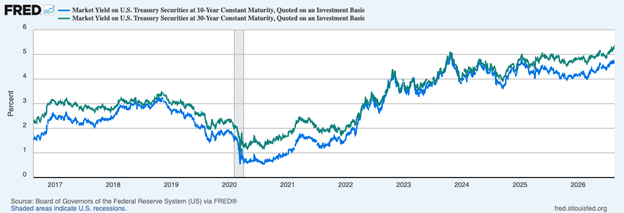
Bond Yields are Rising Globally—A Cause for Concern? Global bond yields have been moving higher, causing some consternation in the stock market and concern among investors. U.S. 30-year Treasury yield recently touched its highest level since 2007, while Germany’s 10- and 30-year borrowing costs hit 15-year highs. Japan’s 10-year government bond yield also climbed near 3%, its highest level since 1996.1
10-Year and 30-Year U.S. Treasury Bond Yields are Climbing
Navigating Inflation in Today’s Market
Today’s market is giving investors plenty to think about. Inflation remains a key focus, and questions about the path of the economy continue to influence stocks and bonds.
For retirees, that makes it important to think about how inflation could affect your savings over time.
Our free guide, 4 Ways to Protect Your Retirement from Rising Inflation3, explores strategies designed to help protect your retirement savings as market and economic conditions evolve. You’ll learn:
- How to build or modify your asset allocation to outperform inflation
- The importance of analyzing your spending by category
- Strategies to maximize Social Security retirement benefits
- Plus, more practical ideas to fight back against inflation
If you have $500,000 or more to invest, get our free guide today! Download 4 Ways to Protect Your Retirement from Rising Inflation3.
Investors raise eyebrows when bond yields rise because of the potential implications. Higher yields can raise the cost of capital for businesses, make mortgages and other consumer loans more expensive, and can pressure equity valuations by making future earnings less valuable in today’s dollars. When yields rise across multiple developed markets at once, investors naturally start looking for the source of the pressure. One question getting more attention is whether the AI build-out is adding to it—a topic Mitch wrote about in a recent column. Corporate borrowing has been heavy this year, with U.S. issuance reaching $1.68 trillion from January through mid-August, up nearly 27% from the same period last year. AI-related issuance has topped $220 billion, already double last year’s total, as large technology companies raise money to fund data centers, chips, and infrastructure. While this marks a meaningful amount of borrowing, it is probably too narrow to blame AI financing for the broader rise in global yields. Investors should think more broadly, as this recent move in global yields appears tied to a mix of inflation, fiscal concerns, central-bank uncertainty, and global supply-demand shifts. Bond yields are still well within historical averages, so we’d hesitate to ring any alarms. But it’s a story worth watching from here.
What the Port of LA Tells Us About Tariffs and Global Trade – Tariffs, war-related shipping disruptions, and higher freight costs have all raised concerns about global trade. But the latest data from the Port of Los Angeles suggest commerce is still proving more resilient than many headlines imply.The Port of LA, the busiest container gateway in the U.S., processed 960,464 total container units in July, making it the port’s second-busiest July on record. Loaded imports totaled 499,552 TEUs, down 8% from last year’s record July but still 6% above the five-year average for the month. If tariffs and global trade disruptions were a real threat, we’re not sure activity at the Port of LA would be this busy.Instead, the data show us how businesses are adjusting to a volatile environment. Companies are moving goods when policy windows open, pulling forward shipments when tariffs may rise, and adjusting supply chains around disruptions. The strength has been supported by resilient consumer demand, retail goods, manufacturing equipment, and components tied to data-center and AI construction. Despite the headline noise around tariffs and geopolitics, at its core this is still an economic growth story.4
U.S. Deficit and Debt Levels Move Back Into Focus – The U.S. fiscal picture is back in focus, with headlines this week reporting that total U.S. debt has crossed $40 trillion. This week, the U.S. Treasury Department also reported a $432 billion budget deficit in July, the largest monthly shortfall since March 2021. Through the first 10 months of fiscal 2026, the deficit reached nearly $1.8 trillion, running above the same period last year. Several factors contributed to the July gap. Medicare outlays totaled $174 billion for the month, Social Security spending was $141 billion, and net interest on the debt reached $104 billion. Tariff refunds also weighed on the budget, costing $33 billion as companies continued receiving rebates tied to duties the Supreme Court ruled unlawful. Interest costs are becoming a larger part of the fiscal story, with gross interest outlays reaching $1.17 trillion so far this fiscal year and net interest totaling $931 billion. For investors, the takeaway is not that a debt crisis is imminent. The U.S. still has deep capital markets and strong demand for Treasury securities. But large deficits and rising interest costs are worth monitoring because they can influence Treasury issuance, bond yields, and broader financial conditions—all of which feed into overall economic health.5
Is Inflation Affecting Your Retirement Plan? With inflation still a key focus, it’s important to consider how rising prices could affect your retirement savings over time.
Download our free guide, 4 Ways to Protect Your Retirement from Rising Inflation6, to learn strategies that can help you prepare for inflation and keep your retirement plan on track, including:
- How to build or modify your asset allocation to outperform inflation
- The importance of analyzing your spending by category
- Strategies to maximize Social Security retirement benefits
- Plus, more practical ideas to fight back against inflation
If you have $500,000 or more to invest, get our free guide today!
Disclosure
2 Fred Economic Data. August 20, 2026. https://fred.stlouisfed.org/series/DGS10
3 Zacks Investment Management reserves the right to amend the terms or rescind the free 4 Ways to Protect Your Retirement from Rising Inflation offer at any time and for any reason at its discretion.
4 HGI. August 18, 2026. https://hgi.io/insights/port-of-la-has-near-record-july-as-importers-navigate-trade-war/
5 CNBC. August 12, 2026. https://www.cnbc.com/2026/08/12/us-budget-deficit-surged-in-july-to-highest-level-since-march-2021.html
6 Zacks Investment Management reserves the right to amend the terms or rescind the free 4 Ways to Protect Your Retirement from Rising Inflation offer at any time and for any reason at its discretion.
DISCLOSURE
Past performance is no guarantee of future results. Inherent in any investment is the potential for loss.
Zacks Investment Management, Inc. is a wholly-owned subsidiary of Zacks Investment Research. Zacks Investment Management is an independent Registered Investment Advisory firm and acts as an investment manager for individuals and institutions. Zacks Investment Research is a provider of earnings data and other financial data to institutions and to individuals.
This material is being provided for informational purposes only and nothing herein constitutes investment, legal, accounting or tax advice, or a recommendation to buy, sell or hold a security. Do not act or rely upon the information and advice given in this publication without seeking the services of competent and professional legal, tax, or accounting counsel. Publication and distribution of this article is not intended to create, and the information contained herein does not constitute, an attorney-client relationship. No recommendation or advice is being given as to whether any investment or strategy is suitable for a particular investor. It should not be assumed that any investments in securities, companies, sectors or markets identified and described were or will be profitable. All information is current as of the date of herein and is subject to change without notice. Any views or opinions expressed may not reflect those of the firm as a whole.
Any projections, targets, or estimates in this report are forward looking statements and are based on the firm’s research, analysis, and assumptions. Due to rapidly changing market conditions and the complexity of investment decisions, supplemental information and other sources may be required to make informed investment decisions based on your individual investment objectives and suitability specifications. All expressions of opinions are subject to change without notice. Clients should seek financial advice regarding the appropriateness of investing in any security or investment strategy discussed in this presentation.
Certain economic and market information contained herein has been obtained from published sources prepared by other parties. Zacks Investment Management does not assume any responsibility for the accuracy or completeness of such information. Further, no third party has assumed responsibility for independently verifying the information contained herein and accordingly no such persons make any representations with respect to the accuracy, completeness or reasonableness of the information provided herein. Unless otherwise indicated, market analysis and conclusions are based upon opinions or assumptions that Zacks Investment Management considers to be reasonable. Any investment inherently involves a high degree of risk, beyond any specific risks discussed herein.
The S&P 500 Index is a well-known, unmanaged index of the prices of 500 large-company common stocks, mainly blue-chip stocks, selected by Standard & Poor’s. The S&P 500 Index assumes reinvestment of dividends but does not reflect advisory fees. The volatility of the benchmark may be materially different from the individual performance obtained by a specific investor. An investor cannot invest directly in an index.
Questions posed are for demonstrative and informational purposes only and may not reflect the views of current clients or any one individual.